


Menu
By theme
By theme




{{ variable.name }} : {{ variable.values[selectedVariantsIndex[variable_index]].name }}
Quantity:
The Golden Light Spell opens with the line that heaven and earth are the mysterious ancestor and the ten thousand qi are the root. In daily Daoist practice it ranks high: morning and evening offices, the purification of an altar, the protection of the body. What it sets out is the gathering of body and mind, clarity within and without. No single school owns it. Zhengyi and Quanzhen both recite it, with a character or two differing between versions while the body stays the same. It is short, under a minute to recite, and saying only the opening lines counts when time is tight, because this is a working text rather than a long liturgical one.
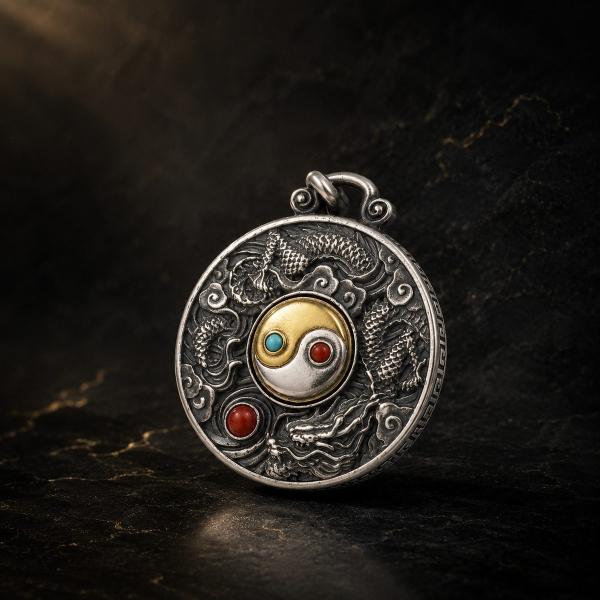
Everyone recognizes the taiji diagram now, but it settled late. In Daoist diagrams before the Song, yin and yang were mostly shown as black and white blocks or as linked lines; the drawing with a dot in each half, like two fish biting each other’s tails, only fixed itself gradually afterwards. The two dots are usually explained as yang within yin and yin within yang, and that meaning matters more than the drawing does. When the diagram moves onto rings and pendants the dots are often lost, because they are too small for a mould to produce. A taiji without its dots is still a taiji, but one layer of the meaning has gone.
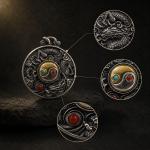
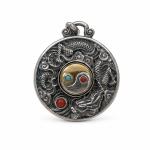
Two dragons chasing a pearl appears everywhere on brocade, on porcelain plates and on signboards, and the pearl is sometimes a flaming jewel and sometimes a taiji. Here the taiji sits in the middle, the dragons come round from both sides, heads turned toward the centre and tails closing at the rim. The arrangement is called two dragons supporting, and what they support is the circle in the middle. The number of claws on a dragon once carried rank; on folk objects three or four is normal, five was for imperial use, and there is no need to be strict about it on a small piece.
The pendant is round and the chain passes through a loop at the top, so it turns and the front does not always face outward. To keep the design fixed, wind a few turns of fine thread around the loop as a stop. A round piece lies flat against the chest and doesn’t swing as you walk, which is the practical advantage over the design; a square plaque is crisper but flips more visibly. A round plaque on a cord is more casual than on a chain and works with either Tibetan or Chinese dress; on a chain it looks formal, good for the office and not too conspicuous.
A silver disc is easily dented. Don’t stack it under other pendants in a box, because a dent won’t come out. Polish the surface with a cloth, pushing in one direction rather than circling, since circling leaves a haze on a flat face. A flat face hides nothing, so pad it with soft cloth when you put it away.