


Menu
By theme
By theme

{{ variable.name }} : {{ variable.values[selectedVariantsIndex[variable_index]].name }}
Quantity:
What Tara holds is not a peony. In thangka painting Green Tara carries an utpala in her left hand: blue-purple, the stem passing through her palm and running up the forearm, one flower open at her ear and one bud at her shoulder. The flower is rare in China proper and few people recognize it, so it is often taken for a lotus. Lotus petals are round and sit on the water; utpala petals are pointed and spurred, and the painting conventions differ, so after enough looking the two separate. Chinese Buddhism translates Tara as Duoluo bodhisattva and treats her as an emanation of Guanyin. In Tibet she stands as a deity in her own right. Different systems, different names.
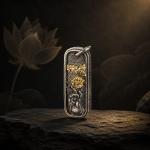
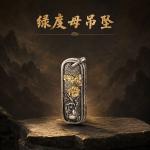
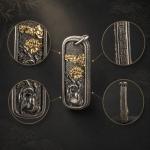
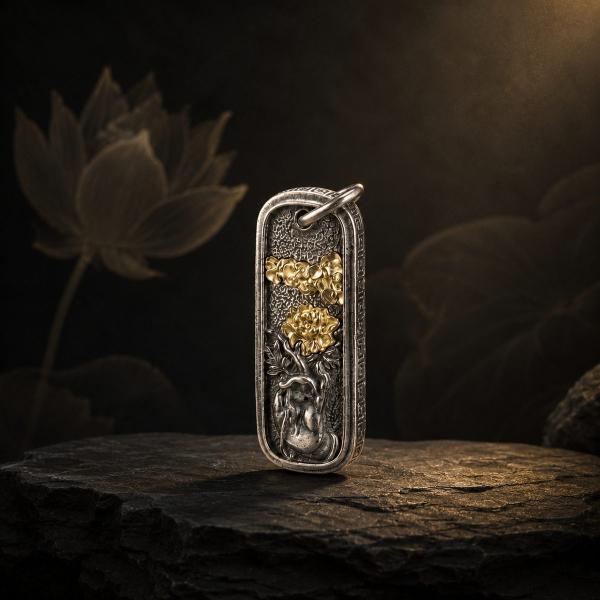
The peony entered Buddhist imagery on Chinese soil. After the Tang and Song, temple murals, stone pillars and offering tables used peony patterns heavily, taking the worldly sense of wealth and rank, which has nothing to do with doctrine. Craftsmen set the two systems side by side without touching the doctrine; what changed was the look of the figure, brought closer to the human world. This pendant puts Tara and peony together by the same route. The peony head is large and Tara’s figure is small, so the proportion has to be tuned: too big a flower overpowers the main figure, too small and it stops reading as a peony. Compositions like this work by letting the flower come in from the side rather than take the centre.
The Tibetan approach is stricter. Thangka painting has its canon of measurements; the proportions of the figure, the hand gestures and the implements follow rules, and the placing of flowers cannot be freely changed. The Chinese approach is looser: flowers can be swapped and backgrounds added. Each has its own logic. One keeps the measure, the other looks for closeness. Which you want is a choice you make at purchase.
The pendant is small, and Tara’s face takes up less than a fingernail. At that size the proportions rest on the ridge of the nose and the set of the chin, and the eyes are cut as two shallow grooves. Cut deep and she looks fierce; cut shallow and it smears. To judge a small figure, don’t count details: hold it at arm’s length and see whether it still reads as a bodhisattva. The depth of the petals matters too. Cut shallow, they are a blur from a distance; cut deep, the flower only appears up close. The two are hard to have at once, and small pieces generally take the first.
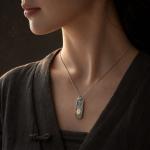
The pendant runs long, so it sits better with a V neck or an open-front cardigan than with a crew neck. Bright silver works best against Tibetan blue, crimson and colours of that weight. Worn against the skin in summer the silver picks up sweat and dulls, which is normal. The back is flat and lies at the neck without pressing, and the edge has been taken round, so there is no thin-blade feel.