


Menu
By theme
By theme

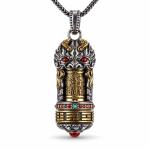
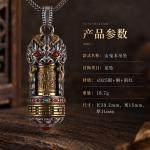
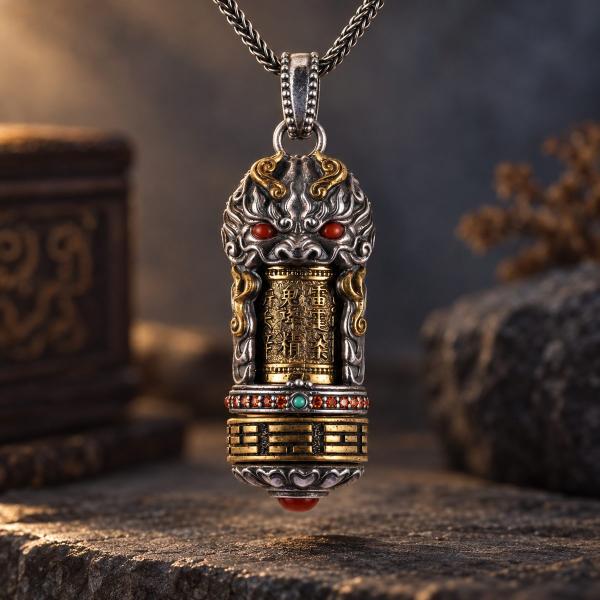
{{ variable.name }} : {{ variable.values[selectedVariantsIndex[variable_index]].name }}
Quantity:
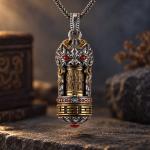
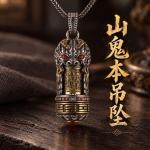
A mountain-ghost charm coin is not for the ghosts in the mountains. The two characters for mountain ghost on the face are part of the talisman head, paired with a ring of talisman script, and the job is to subdue. Old charm coins never circulated; they were cast to be hung, to weigh things down, to be carried. Talisman on one face and bagua on the other is the commonest arrangement. Pieces of this kind passed down for centuries in many versions, and the wording often differs. Readings of the script differ by school, some taking it as characters and some reading the shapes, and an ordinary buyer needn’t go into it; whether the cutting is tidy is enough.
The bagua on the back is usually the later arrangement: qian in the northwest, kun in the southwest, li in the south and kan in the north. Each trigram is three lines, a solid line for yang and a broken one for yin, read from the bottom upward. When a plaque is made, misordering the trigrams is the commonest error. Draw qian as two yang lines and one yin and a layman won’t notice, but anyone who knows sets the piece down at once.
Religious subjects make up most of the charm-coin category: Daoist talisman script, Buddhist sutra text, zodiac, auspicious phrases. What they share is being carried rather than circulated. Charm coins were cast at small local furnaces, and the proportions of copper, lead and tin differed from place to place, which is why surviving pieces vary so much in colour, some reddish and some yellowish. The other line is auspicious phrases: all under heaven at peace, first in the imperial examination, fortune and long life. Many characters packed tight is what smears in the casting. Religious subjects cast better by contrast, since the script runs in connected strokes and a little blur doesn’t show. If the mountain-ghost plaque is cut in relief, the raised strokes wear quickly and round off with use, which is normal for silver.
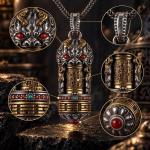
Cutting talisman script on a silver face is hard because of the fine strokes. Talisman characters are mostly written in one unbroken line, and shrunk onto a pendant the gap between strokes is a fraction of a millimetre, so they merge in the casting. A merged talisman keeps its outline but loses its breath. For pieces like this, take a macro photograph with a phone and enlarge it to see whether the strokes run through; that beats the naked eye.
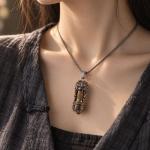
The plaque is small, so use a short chain. Once the silver oxidises the script reads more clearly, so don’t polish too often. Keep it out of a pocket with keys, because a dent can’t be repaired. Some people wear it turned around with the bagua facing out, which is an old way of wearing it too, and you can only do that if both faces are cleanly made.