


Menu
By theme
By theme

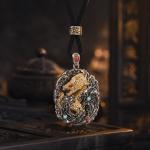
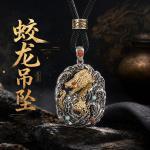
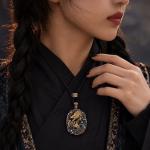
{{ variable.name }} : {{ variable.values[selectedVariantsIndex[variable_index]].name }}
Quantity:
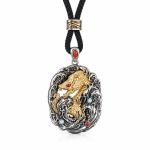
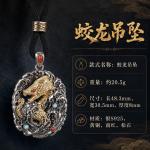
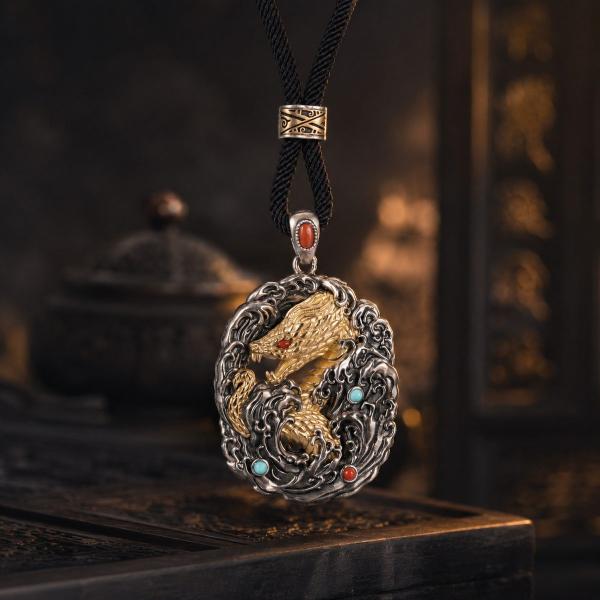
A jiao and a dragon are not the same thing. The old books distinguish them carefully: the scaly one is the jiao dragon, the winged one yinglong, the horned one qiulong, the hornless one chilong. The jiao lives in water, raises wind and waves and causes floods, so in folk tales the jiao is usually a menace and the dragon usually a blessing. That distinction is in the old books; it was not invented afterwards.
Wave pattern on official dress has a name of its own, sea water and river cliff. A band of waves along the hem with rocks standing in the middle carries the sense of rivers and mountains made firm. Ming and Qing dragon robes and official dress all have that band at the hem, the crests layered one over another, and the term for it is standing water. On folk wares the waves are drawn more freely, a few curves and done, with no need to follow the official model. Dragons are said to have nine resemblances: horns like a deer, head like a camel, scales like a fish. The list comes from painting theory, the items vary slightly from writer to writer, and the point is that the dragon is assembled out of a hundred beasts.
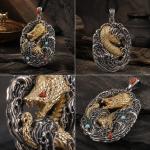
Openwork with waves is expensive in labour. Wave lines are continuous, and openwork has to cut holes in a continuous line, so the silver wire between one opening and the next has to be thick enough or it breaks after two wears. Judge pieces like this by the thinnest wire: excessively fine is a display piece, a little thicker will survive. If the jiao’s scales are cut, each cell should be even; smeared into one mass, the work is wasted. Waves are usually built in three layers, base, middle and crest. With few layers it reads as a band of ripples at a distance; with enough, raking light finds depth. If every crest is cut to the same height it looks stiff, and only uneven heights read as water. The side view shows that most clearly.
The jiao has another use in folk practice: holding back water. Bridges, embankments and well curbs are carved with jiao, meaning to press down what lives in the water so that it doesn’t turn over. That use is more concrete than auspicious beast, and it explains better why the jiao’s image is always tied to waves. It never leaves the water, and out of water it is not itself.
Openwork is light and no burden to wear, and it catches on things easily. Thread from a scarf or a sweater works into the openings and one pull deforms the piece. Take it off by easing it back the way it went on rather than pulling. Clean with a soft brush and don’t soak it. The thin wires darken first, and that darkness brings out the layers of the wave, so there is no need to polish it away.