


Menu
By theme
By theme

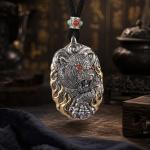
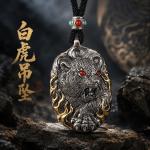

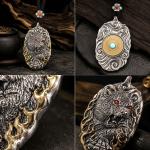
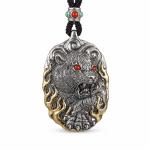

{{ variable.name }} : {{ variable.values[selectedVariantsIndex[variable_index]].name }}
Quantity:
The white tiger is one of the four images, matched to the west, to autumn and to metal. Among the twenty-eight lunar mansions the seven of the western palace join up into something like a tiger, hence the name. The four run blue dragon in the east, white tiger in the west, vermilion bird in the south and dark warrior in the north, a system of directions that settled between the late Warring States and the Han and appears on roof tiles, bronze mirrors and tomb murals. Four groups of seven mansions, each with a spirit, bound the star regions to directions on the ground, and that is the foundation of ancient astronomy.
In the Han the white tiger was a military sign. Tiger tallies for moving troops were made in tiger form and split in two, one half with the ruler and one with the general, and only matched halves raised an army. The white tiger also governs killing, which is why barracks, execution grounds and western city gates carried its image. That layer is a long way from attracting wealth; later ages turned all four spirits auspicious and ground the blade down into a good-luck phrase. Tiger tallies were bronze, and only halves whose mortise and tenon matched were accepted. The practice existed in the Warring States, earlier than the white tiger image.
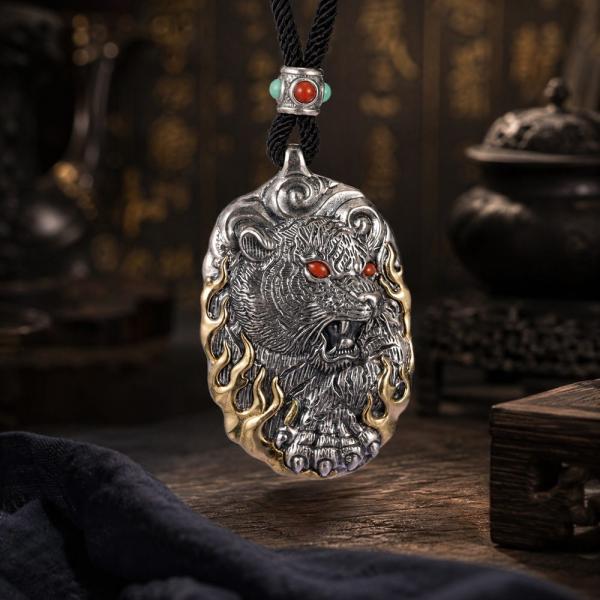
The white tiger belongs to metal and flame belongs to fire, and fire melts metal, so the two together are incompatible in the five phases. Folk pattern pays no attention: the flame is a halo behind a divine beast, there to set off its force, not to match phases. Looking at a piece like this, don’t reason it through the five phases. What it takes is visual fierceness, not astrological fit.
Flame is the hardest part of a relief. Fire has no fixed shape, so cutting it needs hierarchy: one cluster high in the middle, lower at the sides, and the tongues all pointing the same way. Scramble the direction and it looks like a tangle of thread. On bright silver the tips of flames round off easily and go blunt with wear, and there is nothing to be done except knock them about less and put it off. The tiger has another folk use, guarding the house: tiger-head shoes and hats for children, to give them courage. That layer sits closer to daily life than the four images do.
The plaque is on the thick side, and the face against the skin should be flat. Oxidation shows most in the recesses of the flames, so polish along the direction of the tongues rather than across, since across wears the shape away. Store it on its own, not with hard objects; bend one flame tip and the whole fire scatters. Of the four images, blue dragon and white tiger are most often seen as a pair, and a single one is mostly taken for its force.