


Menu
By theme
By theme




{{ variable.name }} : {{ variable.values[selectedVariantsIndex[variable_index]].name }}
Quantity:
On a Tibetan-style strand the fittings have jobs. The buddha head, also called the three-hole bead, sits above the middle, where three lines divide; the stupa fits under the head with its flared mouth downward, gathering the lines; spacer beads divide a long strand into sections for counting; disciple beads finish the end, a few small beads to close it off; the counter hangs separately, a pair of small bell-vajras. Each has a place, and a strand runs badly when a place is wrong. Length matters too: whether a wrist strand wraps three times or four decides how many spacers go on.
Three-phase in the name is not a standard term. The fittings on Tibetan strands are named loosely in Chinese in any case: three-hole bead, buddha head, mother bead, daluo, each region with its own word. Buying pieces like this, asking about the holes is more useful than asking about the name. A single straight hole is a spacer or a runner, a three-way hole is a three-hole bead, and the position of the holes decides what the piece can do. The name is only a label.
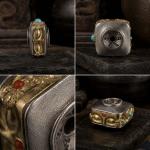
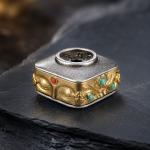
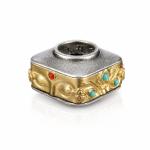
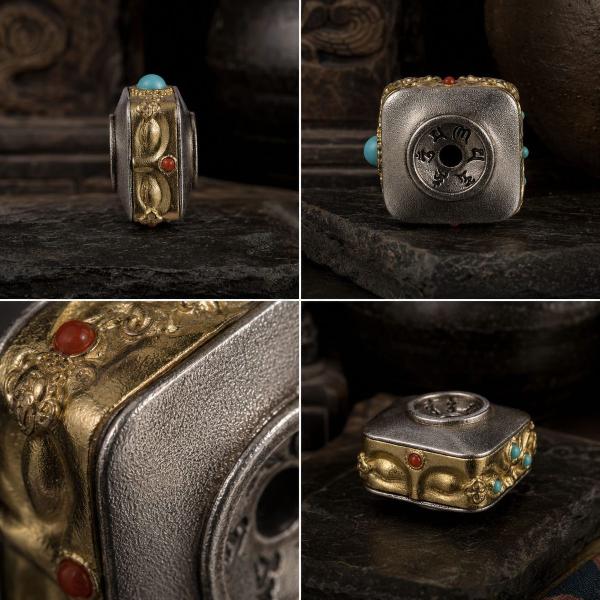
Tibetan fittings are made differently from Chinese ones. Chinese three-hole beads are mostly spheres with holes drilled from three directions; Tibetan ones are often stupa-shaped or drum-shaped, and the better ones carry lotus petals or Sanskrit. Silver fittings are not mainstream in Tibet, where copper, iron and bone are commoner; silver is a precious material and usually reserved for the buddha head, for its weight and its face. Counters come in pairs and hang on either side of the strand, one bead moved per circuit and the round turned over when it is full. They are not ornament, and hung in the wrong place they get in the way.
In stringing, order matters more than material. Fix the diameter of the main beads first, then the size of the buddha head: it should be a size larger than the main beads, since a smaller one can’t hold them and a larger one sits top-heavy. The stupa’s mouth has to match the hole in the head, or the cord jams. Sellers don’t always list these dimensions, so dry-string the whole thing once it arrives and don’t knot it in a hurry; a wrong knot means taking it all apart.
Silver fittings rubbed against beads go bright and take fine scratches. To keep them as they are, add spacers, leather or coconut shell, soft ones better. Clean with a soft cloth and don’t soak: water stays in the holes and dries into a white crust that even a toothpick struggles to reach. If the edges of a hole were not rounded, the cord will break there first. Don’t leave silver against brass for long; the two metals bite each other and the silver blackens first.