


Menu
By theme
By theme

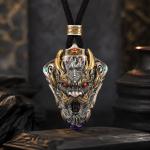
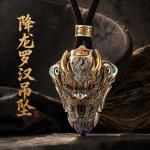

{{ variable.name }} : {{ variable.values[selectedVariantsIndex[variable_index]].name }}
Quantity:
The dragon-subduing arhat is one of the eighteen arhats. The order and the names of the eighteen differ between sources, some putting the dragon-subduer seventeenth and some elsewhere, so the figure is recognized by its attribute: a dragon coiled at the rim of a bowl, or held in the hand. With that mark it is the dragon-subduer; without it, the face alone won’t tell you.
An arhat is a lesser-vehicle attainment, meaning one who has ended affliction and will not be reborn. Chinese arhat images changed from the Five Dynasties onward: from the upright Indian monk to figures old and young, fat and thin, a little strange to look at. Guanxiu painted sixteen arhats with foreign features and Indian physiognomy, long eyebrows, large ears, odd bone structure, and that line had great influence; later arhat images all carry some of his shadow. Sixteen became eighteen gradually after the Song, and which two were added is disputed. Usually Qingyou and Bindula are named, and sometimes the dragon-subduer and the tiger-subduer are counted separately.
The dragon-subduing story is not the same as the Dragon King of the Jing River being executed in a dream by Wei Zheng in Journey to the West. What the arhat subdues, he subdues with a bowl; the Jing River business is about breaking heaven’s law and is settled with a blade. Folk imagery doesn’t care about sources, and if the dragon is at the arhat’s hand the story holds. Pictures of this kind are common on Ming and Qing porcelain bowls, wood carvings and murals. In them the dragon is usually shrunk to a small strip, coiled at the bowl’s rim or around the wrist, taking little space, with the force of the piece depending on it.
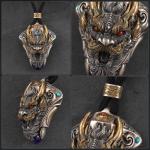
Proportion is the hardest thing in a figure pendant. The arhat’s body, the folds of his robe and the dragon’s head are crammed onto one small plaque: too large a head and it upstages him, too small and it can’t be read. Robe folds should follow the turns of the body rather than lie flat. On bright silver the grooves of the folds break up the light and look busier than they are, which is why figure pieces tend to look full.
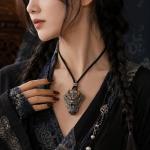
The plaque is long and vertical, so use a medium-length chain. Silver darkens in the recesses, and the dark in the robe folds looks better, so don’t polish it all away. Press with a dry cloth after wearing to take up the sweat. As a gift for an elder this is safer than a Buddha image: it doesn’t ask about the recipient’s school and won’t be taken for an object of worship. Keep the chain short enough that the plaque sits above the chest, or the arhat’s face blurs into a small mass at stomach height.