


Menu
By theme
By theme









{{ variable.name }} : {{ variable.values[selectedVariantsIndex[variable_index]].name }}
Quantity:
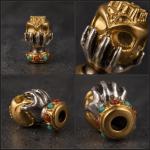
A skull is not an easy subject in jewellery. Set four in a row, each head turned a different way, and they read almost like a row of small icons. This is exactly how the Lords of the Charnel Ground appear in Tibetan sculpture: one foot on the ground, the other lifted as if dancing, a skull cup in one hand and a curved flaying knife raised in the other. The first half of the Chinese name, shituo, transliterates the Sanskrit word for cold; the second half, lin, was added in Chinese to mean a grove, the forest where the dead were laid out. An older translation called it the cold grove. You will find the figure easily enough on thangkas. Fierce, but not snarling.
The spacer takes only the skull. Four versions come out of the same anatomy, numbered one to four, and the differences sit in small places: held singly you cannot tell them apart, lined up in a row the variations show. Silver melts low, so each tooth can be cast clean. The eye sockets have to be sunk deep enough; too shallow and the front reads as two grey smudges. The proportions are the hardest thing to settle. A crown too round turns the piece into a bead, cheekbones pinched too quickly turn it into a monkey's face, and the point between the two can only be found by reworking the mould. The hole runs from the crown straight through to the base and the wall has to be true; polish it once and the cord runs smooth. Off by half a degree and the cord bears on the rim and wears through there. After polishing, the inside of the channel keeps a faint matte that disappears when you thread something dark.
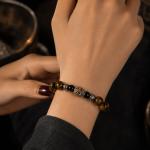
Two in a strand is enough. Place them either side of the centre and they divide the main beads into three sections; more than that and the strand starts to look broken up. Silver is heavier in the hand than wood and over time it drifts downward of its own weight. Before you tie off, hang the strand on the back of your hand and see where the balance falls. In a strand silver is the hard thing and wood is the soft thing, so where the two touch it is the bead that wears, not the silver. That is why the main beads beside a silver spacer age first. The mouth of the hole is where cord frays worst. Use a double strand, and replace soft cord as soon as it fuzzes rather than wearing it another season.
Dark materials are the safe pairing. Coconut shell, dark sandalwood and old bodhi seeds all hold it, and the white of the silver becomes a single small bright note in all that darkness. Southern red agate or amber will make it jump; that is a matter of taste. It also works off a strand entirely. Take one as a small pendant on a dark braided cord and let it sit in the hollow of the collarbone. Cleaner, in some ways, than being one element in a crowd.
The subject is not obscure in collecting circles, but some people do object to it. Ask before you give one as a gift; it saves an explanation afterwards. Sweat and grime collect in the bone lines. Brush with a soft toothbrush and clean water along the seams, never pick at them with a needle. Leave the black in the eye sockets. That is depth, not dirt.