


Menu
By theme
By theme




{{ variable.name }} : {{ variable.values[selectedVariantsIndex[variable_index]].name }}
Quantity:
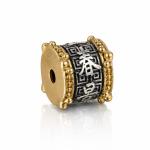
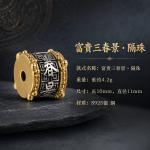
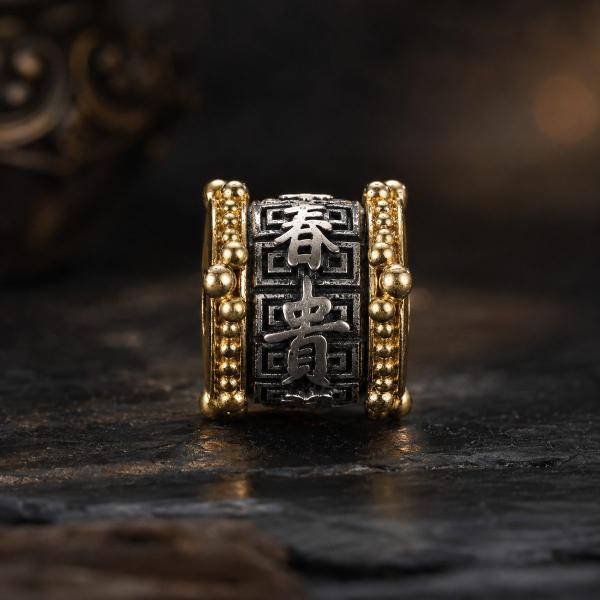
The key fret is a pattern made from a single line carried all the way through: level and plumb, square at the corners, each turn folding back inside the one before. Its ancestor is the thunder pattern on Shang and Zhou bronzes, cut deep in those days and laid out cell by cell. Later the line was drawn out into a continuous loop, and folk art gave it a pleasant name, wealth and honour without a break. The name is common enough, and the meaning is plain: do not break.
Three Springs of Wealth and Honour is a title from another tradition. The three springs are the first, second and third months, which is to say the whole season, and the peony is the flower of wealth and honour among ordinary people; the three springs with a peony asks for wealth that lasts. Titles of this kind turn up constantly on New Year prints, woven silk and painted porcelain. Translated onto a silver spacer, only the skeleton survives; there is no room for leaves or petals. So the three springs on a spacer are usually no more than an outline, and whoever knows the reference will recognise it.
The hard part on a spacer is the join. The fret has to come back round to where it started, and a poor join shows immediately. The way it is done is to hide the break at the side of the bore, so the front reads as continuous and only turning the bead gives it away. Casting shrinkage has to be calculated in. Be off by a little and the closing cell will not meet, and the whole piece goes back into the crucible. Shrinkage is not the same in thin and thick sections either; on a single bead the side with more grooves pulls in harder, and the allowance has to be made for that when the metal is weighed out.
It is easy to wear. As a spacer, put it at the centre of a strand of plain beads with three main beads on either side and the rhythm is right. It also works as a small pendant on a fine cord of its own, sitting in the hollow of the collarbone. The white of silver is a cool white, safe with dark beads and plain clothing, noisy against bright red or green. On the wrist the fret turns with the wrist and does not feel awkward.
The grooves are narrow and collect dust, so rinse the piece when you shower rather than digging at it afterwards with a needle. Once the silver tarnishes, the hollows go black while the ridges stay bright and the pattern jumps out; do not be in a hurry to polish it white, because it looks better left. If you must polish, take a silver cloth along the line. Rubbing across it dulls the corners. Shallow grooves have a second advantage, in that they hold less dirt and do not look soiled after long wear. On silver the square corners want a touch of rounding, or they will pull thread.