


Menu
By theme
By theme


{{ variable.name }} : {{ variable.values[selectedVariantsIndex[variable_index]].name }}
Quantity:
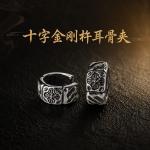
A grip in the middle and a vajra at either end, each head divided into prongs, whether three, five or nine. The vajra began as an ancient Indian weapon and later took on the form of a ritual object. The cross vajra sets two of them at right angles with the four heads facing the four directions, and the trade also calls it a karma vajra. What it stands for is everywhere at once: the four quarters and the four corners all held, which is why it is set at the corners of a mandala. In Tibetan practice the vajra also serves as a counter. A small one hangs from a mala and is moved along after each circuit.
Made as an ear cuff, the size is fixed by the ear. The cartilage of the helix is thin and cannot carry weight; make it heavy and it aches within the hour. This one is scaled to the width of the helix, and the angle at which the four heads open is kept small, or they press against the rim of the ear. Silver is springy and the grip comes from that arc, but once the arc has been bent wide it will never grip again. So put it on by sliding it up along the helix rather than prising it open and clamping it down.
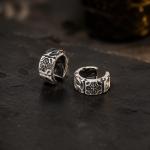
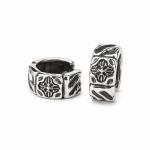
The four heads are where the work sits. Each carries three prongs, and at this size the gap between them is a hairline, so in casting they tend to run together into a flower. The way to check is to look from the side: the four heads should stand at the same height and light should pass through the gaps. The grip has a band of fine lines cut around it, which both stops it slipping and marks the waist of the vajra. The body should not be polished too bright. Bright makes it feel light; a matte layer gives it weight.
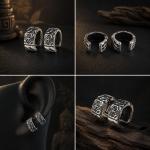
For anyone without a pierced ear it is the easiest thing to wear: push it onto the helix and it stays. It sits at the middle of the rim of the ear, and too high up it will fall off. One on each ear makes a pair, and one alone also works, with the other ear left bare, which is cleaner. Short hair shows it whole and long hair covers half of it. It is not made for sleeping in, since it hurts when pressed against the pillow. On a thick helix it can be worn all day without discomfort; on a thin one you will want it off by noon.
The cuff loosens with wear, which is inevitable. Do not bend it by hand, because every bend costs grip, and when it has gone loose, replace it rather than reaching for pliers. Take it off before showering; water collects in the gaps and blackens them. Wipe it with a soft cloth when the silver dims, and support the heads while you do it, since they are fine and will catch in the cloth. Do not carry it loose in a bag. Once it has been deformed it will not go back.