


Menu
By theme
By theme


{{ variable.name }} : {{ variable.values[selectedVariantsIndex[variable_index]].name }}
Quantity:
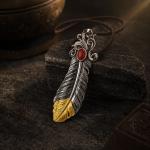
The feather is not a regular in Chinese ornament. In traditional auspicious patterns the birds are phoenixes, cranes and ribbon-tailed flycatchers, and feathers appear only as attachments; a feather on its own does not make a picture. Phoenix feathers and crane feathers belong to the bird, and taken away from it they lose the design. The feather as a piece of jewellery in its own right is a modern thing, and the associations come from roughly two places: the headdresses of native North America, where a feather stands for honour, and the eagle feathers of Tibet, used on hats and ritual objects. Neither is a Chinese root.
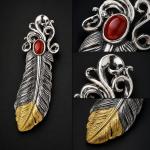
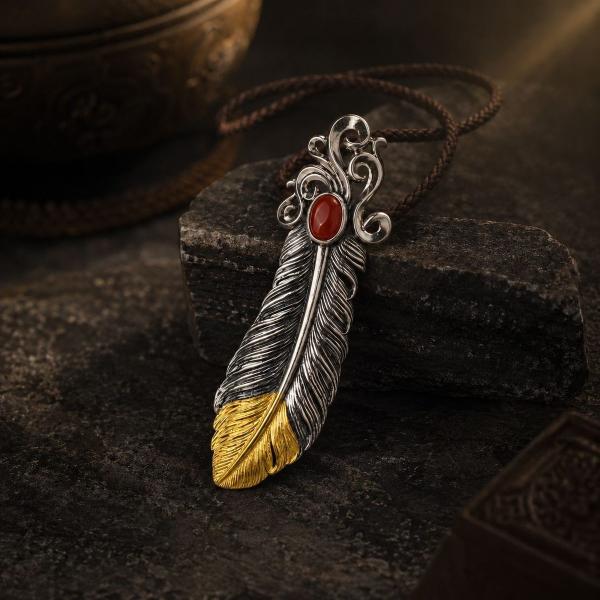
So the interest here is not in the source but in the form. A feather has a shaft down the centre with barbs running out at an angle on both sides, finer and finer toward the tip. Southern red agate in this shape is difficult because of the thinness. Thick, and the feather loses its lightness; thin, and it chips, especially at the very point. The trade's method is to leave the shaft thick and shave the barbs away to either side until they pass light without going transparent. Cracks in southern red usually sit at the edge, so look at the edge first when the rough is chosen.
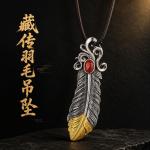
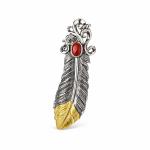
The silver frame holds only the base and leaves the body of the feather bare, so that the stone speaks for itself. A frame too wide presses on the barbs, too narrow and it is not secure, and the width took several versions to settle. The red of southern red is warm, and against the cold of the silver the outline of the feather reads more clearly. If the surface of the stone is uneven, light scatters inside it and the layering of the barbs never appears.
Wear it with the tip down. Tip up looks as if it has been tucked into the collar, which is awkward; tip down follows the line of the body, and the pendant lies against the clothes instead of flipping over. Use a fine cord, since a thick one fights the lightness of the feather. Dark clothes are best: wine red, deep green or black all work, while pale colours make southern red look soiled. In summer, with a camisole, the tip will rub against the collarbone, so raise the position a little. The tip catches worst on the threads of a sweater, so tuck the pendant inside when you wear a coarse knit.
Southern red chips, so do not store it with hard objects; the tip is the most fragile point of all. The silver frame darkens as it oxidises, and the soft cloth should go around the stone rather than across it. A feather is not meant for daily wear. Take it off into a small bag with a layer of soft cloth between. The colour of red stone survives storage well; what it fears is a knock. The cord passes through a small hole at the base rather than around the body of the feather. Southern red dims when it takes sweat, so press it with a dry cloth when you get home. If dust works in between the silver and the stone, a soft brush lifts it out.