


Menu
By theme
By theme

{{ variable.name }} : {{ variable.values[selectedVariantsIndex[variable_index]].name }}
Quantity:
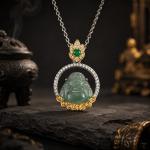
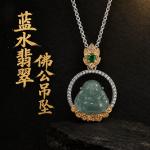
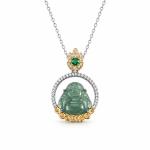
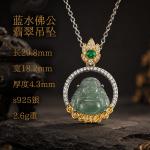
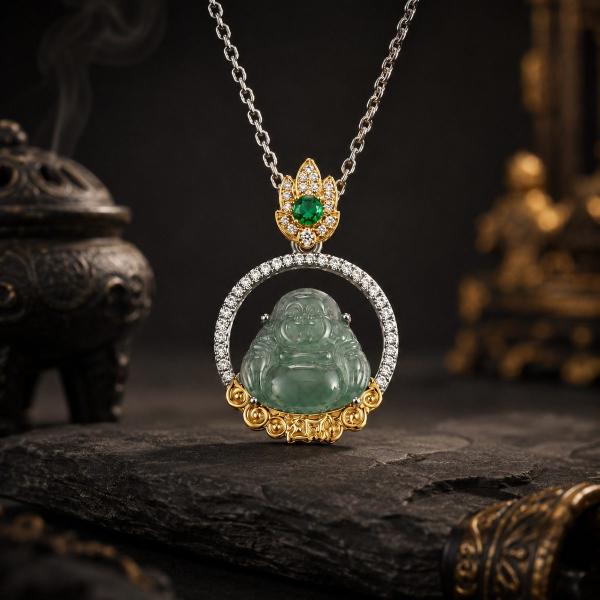
Every batch of what is sold as blue water Buddha material has a different blue. Some lean grey, some lean green, and some show almost no blue in daylight at all, only under a lamp. This one sits in the middle: grey-blue on an overcast day, a touch of green in sun. When buying this kind of stone, do not judge it only inside the shop; walk to the doorway and look again in daylight, and the difference will show. The water in blue water means transparency — how far light goes in. The trade grades it as one part water, two parts water; the language is rough but it works.
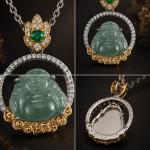
The belly is the easiest place to read the work. A well-carved belly shows a full arc in profile, with its highest point a little below centre; a flat one saves material, and an over-inflated one is trying to look thick and usually loses proportion. This belly is moderately full, which suits a small plaque without making it look like a ball. The navel is cut as a shallow whirl, not deep, so light landing on it leaves a small dark point. The ears are a coded signature of the carving: thick lobes and deep ear holes mean the block was thick enough to cut into, while a saving carver lays the ears against the side of the face and cuts only an edge.
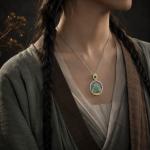
Popular saying has it that Maitreya's broad belly holds everything and his mouth is always open in a laugh. The line has been repeated so often that it has gone stale, and yet in front of the object you still feel it: once the corners of the mouth lift, the whole face relaxes, and the wearer relaxes looking at it. That is also why the Buddha figure outsells other subjects — it suits anyone and any clothing. Old customers look at the mouth first, then the belly, and put colour last. Reverse that order and you buy good colour with poor carving.
The setting has an open back and four corner claws at the front. The opening is generous so light gets in and the stone does not go dead. The corner claws are shaped like petals — four small arcs from the front, softer than points. The back of the setting is polished and does not scrape the chest. The piece has weight in the hand with the setting on, which says the material is not thin; a very light piece usually means the back was hollowed aggressively. The silver will change colour with time — first a yellow cast, then grey, then black — and that sequence does not show in photographs.
In summer, with heavy sweat, a grey-white film builds on the side of the setting that touches skin; a soft brush with a little neutral detergent takes it off. The jadeite itself does not mind sweat. What it minds is going hot and cold; do not wear it into a sauna. If the chain is silver too, polish both together so you do not end up with one bright and one dull. If a claw point lifts, press it back with a fingernail, not pliers — the jaws leave tooth marks.