


Menu
By theme
By theme




{{ variable.name }} : {{ variable.values[selectedVariantsIndex[variable_index]].name }}
Quantity:
Om mani padme hum. Those six syllables are nothing rare in Tibetan country: cut into the stones of mani walls, rolled inside prayer wheels, repeated by old people under their breath. They are held to be the heart mantra of Avalokiteshvara, and explanations of the meaning are many; the one heard most often is the jewel in the lotus, which takes the awakened mind for a jewel. The syllables are a transliteration of Sanskrit, and Tibetan and Chinese pronunciations differ. On a ring they are usually cut in Ranjana, a Sanskrit script with square, angular strokes that begin and end on a pause — clearer on a narrow band than Devanagari.
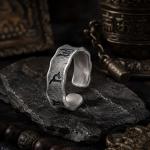
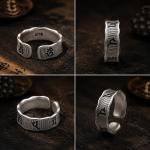
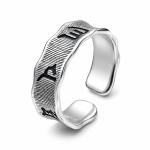
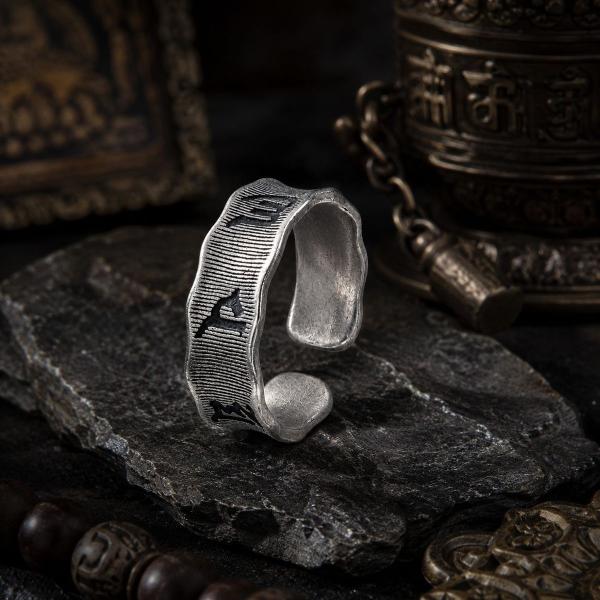
The face of this ring is a flat wide band, and the six syllables are set along the curve one after another, separated by short vertical strokes. The characters are cut in, not raised. Incised lettering does not wear flat — after years of wear the syllables are still there — but it does collect dirt, and needs a brush. The spacing is even, and there is a little blank ground at the beginning and the end so the text does not run into the edge.
The wave edge is the other thing to look at. A raised, undulating rim runs along both sides of the band, like water, or like the silhouette of a string of beads. That edge is not only decoration: it gives the band its thickness and keeps it from deforming when squeezed. An open ring's great fear is going soft with repeated adjustment, and the reinforced edge holds the shape longer. The waves are cut shallow — deeper would press into the finger and collect dirt in the hollows — and the spacing is divided according to the length of the band.
Open and adjustable means the ring can be opened or closed a little, so no size is needed. When you adjust it, move both sides; bend one side only and the circle goes out of true. Silver is tough and will not snap under slow pressure, but working the same spot back and forth for a long time raises a white line — metal fatigue, which looks like a crack and is only skin deep.
Index or middle finger both work, with the wide face up and the syllables turned toward you. Take it off to wash your hands or the dishes — soap collects in the lettering and dries to a white ring. When the silver darkens, press a silver cloth into the characters rather than using a stiff brush, whose bristles drag the dark out of the grooves and make the text less legible, not more. Worn long, the edges of the lettering round over and the characters soften. That is silver being silver.