


Menu
By theme
By theme

{{ variable.name }} : {{ variable.values[selectedVariantsIndex[variable_index]].name }}
Quantity:
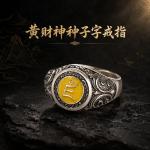
In Tibetan practice the wealth deities are not one figure but a group. The five families are red, yellow, white, black and green by body colour, and Yellow Jambhala stands first, governing resources. His seed syllable is not the same order of thing as White Tara's long-life character: the strokes are squarer and the turns harder, which actually makes it easier to read on a small silver face. The character is a whole and may not be broken up as ornament — that is the rule. When the five are painted together, Yellow Jambhala usually sits at the centre with the others ranged to either side, the commonest arrangement in thangka, though he is also painted on his own, without the others.
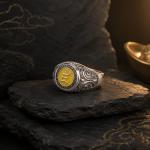
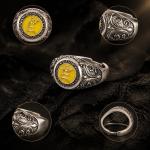
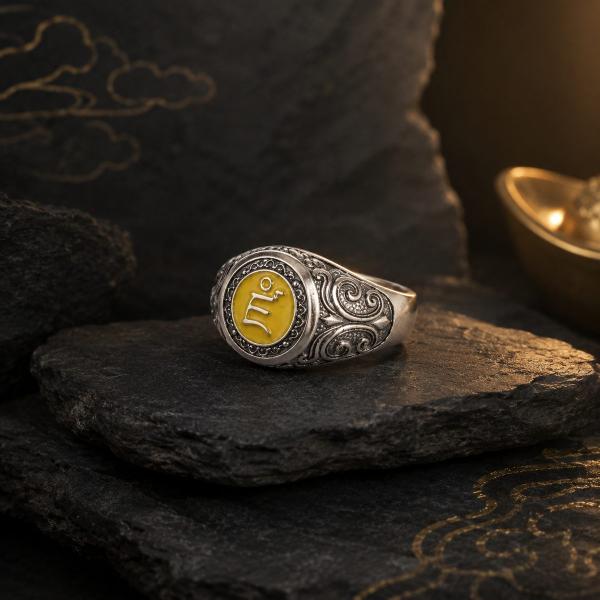
The face is wider than usual, to fit the character. The character takes the middle two thirds, with a thin line on either side and a plain field beyond that. The cutting is intaglio, the groove V-shaped, so light entering at an angle brings the strokes out; under flat frontal light the character goes dark, and that reticence is what intaglio does. There is a pause mark at the opening stroke, the deepest cut on the piece, where light gathers into a small bright point.
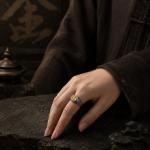
An open band, adjustable, with the two ends not soldered but left to overlap. The overlap is chamfered so it does not scrape the finger. Silver is not hard, and in time the overlap polishes to a bright mark; that is the structure, not a flaw. Adjust it by pinching the ends, not the middle — the middle collapses.
Yellow Jambhala is yellow and the ring is silver; the colours do not match, and there is nothing to be done about it. People have asked why it is not gold plated. A gold-plated silver ring loses its colour at the corners within two months, and the silver showing through looks worse than no plating at all. Natural white silver, as it ages, takes an even dimming, which wears better. That is a trade-off in the design, not a shortcut in the finishing. The plain fields on either side are left uncut so the character has room to breathe; fill them and it suffocates.
Do not wear this ring for moving heavy things. Silver is soft: pressure distorts the band and knocks small dents into the lettering. Take it off to wash your hands — water sits in the grooves of the character and dries to a white deposit. When you polish, follow the direction of the strokes; rubbing across them smears the dark out of the grooves and the character goes vague. Silver-white on Yellow Jambhala is the wrong colour and the right meaning, which is a line I have had to explain to a good many customers over the years.