


Menu
By theme
By theme




{{ variable.name }} : {{ variable.values[selectedVariantsIndex[variable_index]].name }}
Quantity:
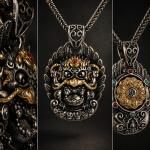
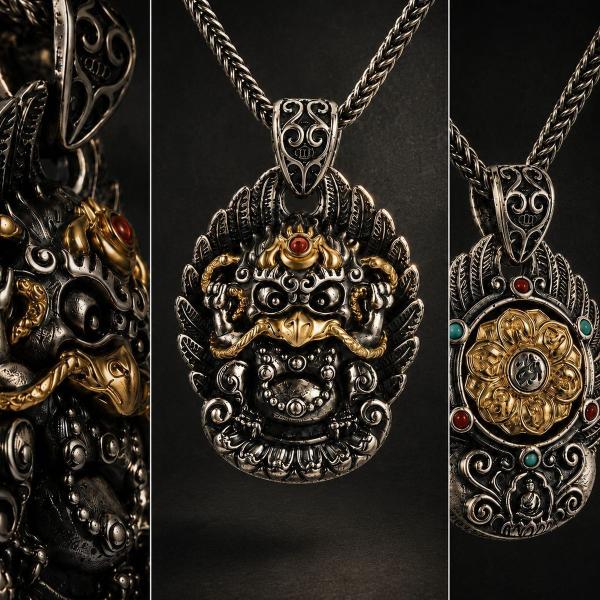
The Garuda came from India, where the Sanskrit name is garuda and the figure is counted among the eight classes of divine beings. In Tibetan country its position changed: it became a protector, with a particular brief against the troubles the naga spirits bring. Its form follows a fixed description — bird body, horns on the head, a beak hooked like an eagle's, three eyes, wings spread, a snake gripped in the claws. On a pendant the snake is often dropped; the wings and horns never are. The Garuda also appears in Chinese temples, set on the roof ridge, but the use there is not the same as in Tibetan country.
This one is antiqued. Antiquing is not making silver dirty; it is letting the recesses go dark first while the raised surfaces stay bright, and using that contrast to press out the layers of the feathers. The feathers on the wings are cut as rows of arcs, evenly spaced and evenly deep, which is the die's work. Done well, the dark in the recesses is matte and does not reflect; done badly, it goes greasy and looks painted on. The tips of the feathers sit at the outer edge and are made thinner than the inner rows, so light leaves a thin bright line along the rim.
The head takes a good share of the piece. The horns are short, rising from either side of the forehead — two small bumps from the front. The beak hooks downward, its point rounded so it does not prick. The three eyes are given as three arcs only: the middle one vertical, the two outer ones horizontal. No pupils are cut; the eyes are left blank, so from any angle they seem to be watching you.
Pendant only, no chain. With cord, choose a heavier one — the bird's wings are wide and a fine cord cannot hold it. Knot the cord through the hole at the back of the head; threaded that way the pendant hangs true. A man can wear it outside the shirt: in winter, against a dark coat, the bright edge of the silver shows a little through the wool. Dark red or black cord are both safe, and red against bright silver is a common pairing in Tibetan country.
Do not take a silver cloth to the whole piece: the dark in the recesses comes off, everything goes one colour, and the antiquing is wasted. To clean it, dry-brush with a soft brush and lift the loose dust. If you want brightness, let it be on the wing tips and the horns, which are meant to be bright. The silver will go on oxidising, taking on a deeper tone year by year, and that is not reversible. The wings are the thinnest part of the piece — the tips are thin as paper, and a knock will curl an edge. Once curled, it can only be eased back slowly.