


Menu
By theme
By theme



{{ variable.name }} : {{ variable.values[selectedVariantsIndex[variable_index]].name }}
Quantity:
Butterflies appear early in jewellery — on Tang silver hairpins, and by the Song usually with both wings spread. Their advantage is bilateral symmetry: set one on a ring face and the centre of gravity settles by itself. Carvers like them for another reason: the veining on the wings can run from full coverage to a single edge line, and both work. Song butterfly pins were mostly pairs in flight; by the Ming and Qing the butterfly was paired with melon or with flowers, for the wish of unbroken generations.
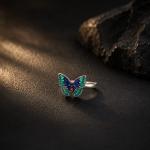
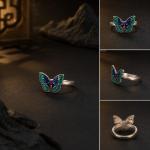
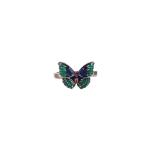
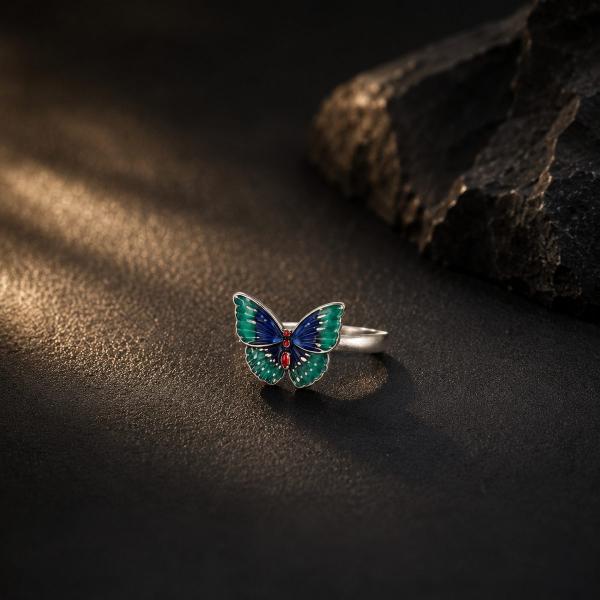
This one takes the simple route. The wings are divided into three sections — forewing large, hindwing small, a groove between them — and the antennae are two fine lines lifted clear. After antiquing, the hollows of the wings are dark and the edge lines stay bright, so from a distance it is a dark butterfly settled on the hand. The antennae break most easily, so they were thickened slightly; head on they look a little blunt, and only in profile do they read as fine. That is a concession to durability. Two small notches are cut into the lower edge of the hindwing: a butterfly's wing has a tail projection, and cut straight it would look like a moth.
An open band, with the butterfly at the centre of the face and its wings just overhanging the band, a little on each side. The overhang is intentional; gathered entirely inside the band it would look constrained. The opening sits behind the body of the butterfly, hidden by the wings, so it does not show from the front — standard practice for an open ring.
The antiquing is a thin layer, and a knock leaves a bright spot. The edges of the wings take the table edge most often; a lively hand will find them. There is no repair — you wait for the whole piece to oxidise again and cover the spot, which takes time. Do not set it down on porcelain when you take it off to wash your hands: porcelain is harder than silver and one contact leaves a white mark. The opening sits slightly left behind the body; if it presses, turn it toward the palm.
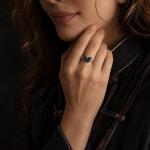
On dark clothing the butterfly reads most clearly — black, navy, dark brown all work. On pale clothing it becomes an outline, like a faint pattern in the cloth. On a slender finger an open band looks large; close it a little, and afterwards pinch the two ends so the opening lines up. The wings are slightly wider than the band, and at that width they do not catch a cuff; any wider and they would. The body is narrow while the band has to carry the whole butterfly, so the silver at the back is thicker than at the front.