


Menu
By theme
By theme




{{ variable.name }} : {{ variable.values[selectedVariantsIndex[variable_index]].name }}
Quantity:
Botanically the lotus and the water lily are not the same plant, but in jewellery the two are used interchangeably. The Buddhist lotus stands for rising unstained out of mud, an image so strong that the flower carries it into ornament automatically. Folk usage adds a pun on many sons, taken from the seed pod and its crowded seeds. The two readings coexist, each in its own setting. The flower blooms from June to September, and on a real plant the petals open in layers; carve them in that order and the turning edges look true.
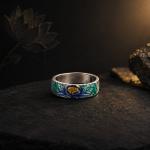
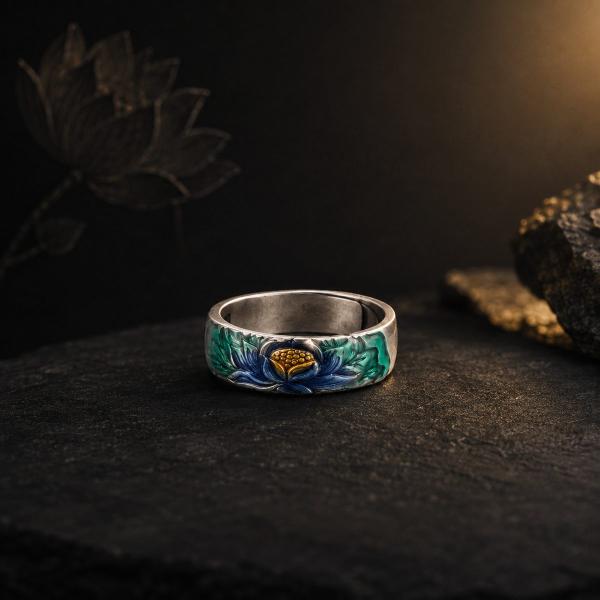
The lotus here is half open. The outer petals turn outward, the inner ones are still closed, and a sliver of the seed pod shows at the centre. The edges of the petals are undulating rather than a smooth line, so light breaks along them the way it does on a real petal. The tips are slightly blunt rather than pointed, and do not catch knitwear. Only the top of the pod is exposed, with a few holes cut in it; a full set would be crowded and will not sit on a small piece.
The band is fine, and only the flower head is wide. A fine band is light on the hand but deforms easily; when you take the ring off, do not pull at the flower — hold the sides of the band. Once adjusted, silver sits a little looser, which is the metal springing back, so do not close it in one go; take it in over two or three passes. The section of the band is flat and lies against the finger, so unlike a round section it does not rotate. The head is soldered to the band, with the joint on the back of the petals, and after polishing only a faint trace remains.
The flower head is on the large side and takes up room on the hand, so on short fingers it looks crowded. The design suits long, slender fingers, or a little finger as a pinky ring, where the proportion comes right. Some people buy it as a scarf ring, flower outward, the band gripping the fabric; I have seen that a few times and it works. For a scarf, the band has to be closed to the point where it holds the cloth without pinching a crease into it, and that has to be tried.
Silver darkens, and the hollows of the petals darken first because sweat collects there. Past a certain point the dark improves it — the layering of the flower reads more clearly. To keep it bright, press a silver cloth onto the petals rather than rubbing along their length; a long stroke rounds the edge line and the flower goes blunt. Lotus pieces sell best in summer, and are worn in summer, a pattern that has not changed in years.