


Menu
By theme
By theme


{{ variable.name }} : {{ variable.values[selectedVariantsIndex[variable_index]].name }}
Quantity:
The tiangou in the Classic of Mountains and Seas is not a dog in the sky but a beast on a mountain. The Classic of the Western Mountains describes Mount Yin: on it is a beast shaped like a leopard cat with a white head, named tiangou, whose call sounds like liu-liu, and keeping one wards off misfortune. Warding off misfortune meant blocking disaster, which the ancients counted a practical function, and that is why the tiangou has always been carried as an auspicious beast. Later ages confused it with the tiangou star and with Xiaotianquan, the dog of Erlang Shen — three different things. The phrase wards off misfortune is in the original text, and is more reliable than the later embroidery.
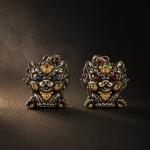
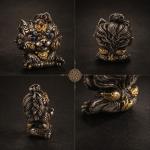
This one is couchant: head low, forepaws together, back arched, tail coming round the flank to rest on a hind leg. A white head cannot be shown in stone, so the head is given a silver bezel instead — white head turned into white edge, a compromise. The eyes are two fine slits with no pupils cut. The silver covers only the head and the two forepaws, not the body, so plenty of stone shows and the animal stays whole. The arch of the spine is the skeleton of the piece, running from the nape to the tail; break the arc and the animal goes slack.
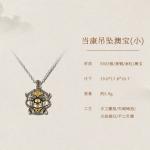
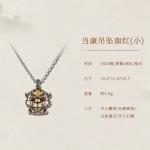
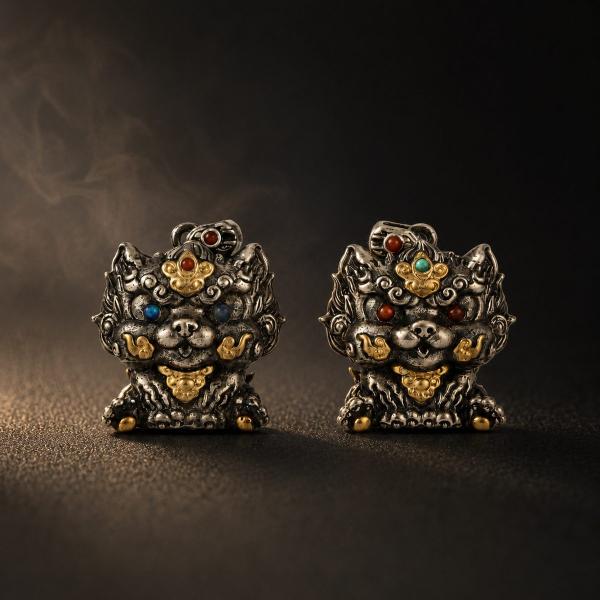
Two versions, South Red agate and Australian opal, both small. Small sits close to the body: a beast like this grown large turns fierce, and small it becomes a charm. The South Red is a darker red and sits heavy against the silver; the opal shifts with the angle, blue and green light moving across it, and reads bright. One design, two materials, two entirely different temperaments. The moulds were made separately at different reductions, and the size of the head differs measurably between them.
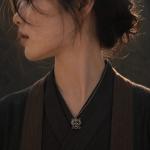
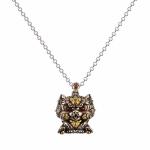
The hole is drilled through the spine, so the head hangs forward and down, against the chest. Use a fine cord; a thick one will bulge out of the hole and hang the pendant crooked. Some people hang it from a bag instead, where silver and leather sit well together. The animal is small, and on a cord it reads as a little plaque — at a glance you would not know it was a beast.
South Red dislikes dryness, opal dislikes temperature swings, and neither survives an ultrasonic bath. Clean with a soft cloth; opal can take a barely damp one if you blot it dry at once. Where the bezel is pressed thin, do not pick at the seam with a fingernail — every pick loosens it, and a loose bezel lets the stone shift. Once it shifts the bezel has to be re-pressed, and a second pressing never sits as well as the first. Both versions are hand-checked, and the edge of the hole is chamfered so the cord cannot be cut at the mouth. Dark brown cord for the South Red, black for the opal: one warm, one cool, according to taste.