


Menu
By theme
By theme





{{ variable.name }} : {{ variable.values[selectedVariantsIndex[variable_index]].name }}
Quantity:
The brightest star in the east before dawn is Venus. Appearing in the east before sunrise it is called Qiming, the opener of light; appearing in the west after sunset it is called Changgeng. The ancients took these for two stars for a time — a poem in the Book of Songs sets the two names side by side, Qiming in the east, Changgeng in the west. Once it was known to be one star the names stayed, one for morning and one for dusk. Venus is a planet and stays close to the sun, which is why it always appears low before sunrise or after sunset and never overhead at midnight.
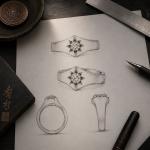
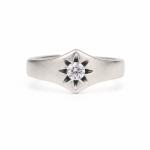
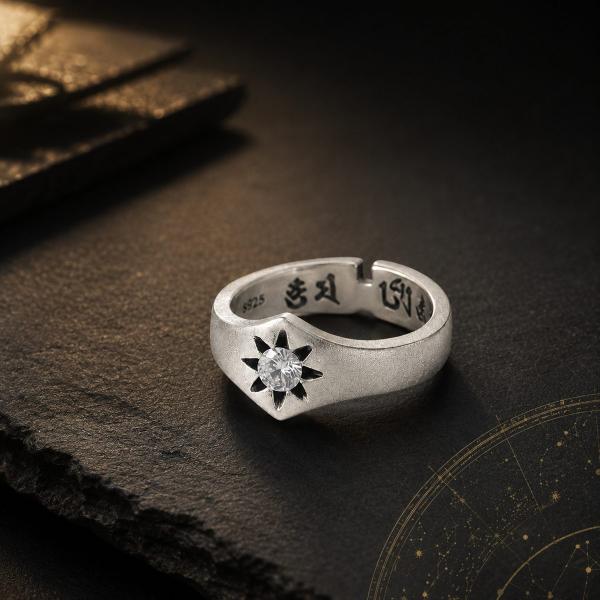
The totem here is a star, but not drawn as a five-pointed one. There is a dot at the centre with lines radiating out at different lengths, each ending in a point — the whole thing like a mark cut into stone. The uneven length is the point: equal rays would look like a sun, and only irregular ones read as a star. The lines are cut shallow, and after polishing only a slight depression is left, almost invisible straight on and showing only in raking light. The tips do not sit at a consistent angle — some point up, some slant — and that is what keeps it from looking stiff.
An open band, with the star at the centre of the face. The section is round, which is comfortable on the finger; the drawback of a round section is that it rolls on a table, so mind where you set it down. The opening has no ornament, just two rounded ends, plain. The silver is left in its own colour, unplated and un-antiqued: bright when it is bright, and a soft grey-white as it dims.
A radiating pattern like this suffers most from being cut too densely. Crowd the lines and, reduced to the size of a ring face, they collapse into an ink blot with nothing legible in it. Here only a few lines are kept, staggered in length and unevenly spaced, and at actual size they can still be counted. The longest runs straight up; it was cut first, and the others took their length from it. In small work, subtraction is harder than addition.
Worn daily, the face of a silver ring flattens slightly and the lines grow shallower; there is no preventing it when the ring meets desk and keyboard all day. To slow it, turn the ring toward the palm while you write. A soft cloth with a little toothpaste will clean it, but not a coarse paste — coarse grit fills shallow lines in. This piece is not antiqued, the silver is clean, and the pattern depends entirely on the shadow in the cuts, so in weak light it almost disappears.