


Menu
By theme
By theme



{{ variable.name }} : {{ variable.values[selectedVariantsIndex[variable_index]].name }}
Quantity:
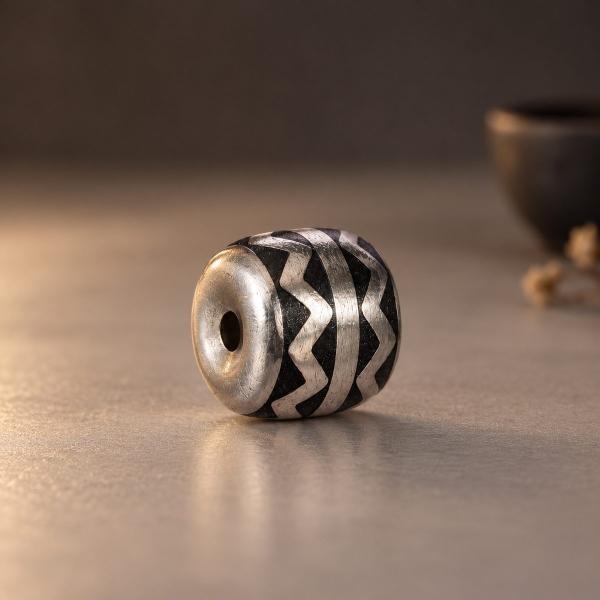
Flatten a dzi bead and you have a dalu. It is short and round with the hole running across, so a strand of them reads as a row of discs; an ordinary dzi is a long barrel, and a dalu is half or even a third of its length. In Tibetan country the dalu is held in high regard, and an old one costs no less than a long bead, because few survive. There are many theories about what dzi beads are made of — agate, some say, chalcedony others — and the material of old beads is not the same as modern work. That is a subject for elsewhere.
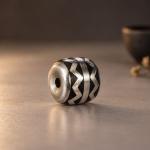
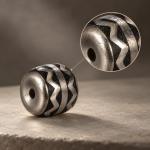
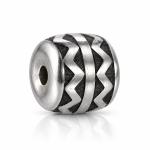
This one carries a water pattern: several continuous waves running around the body of the bead, crests and troughs aligned, with the join hidden under the hole so no break shows. Water lines are not the commonest dzi pattern — eyes and zigzags are — and the meaning usually given is unbroken flow, which can be listened to without being taken too seriously. The crests are rounded and the troughs sharpened, which makes the water look as though it is moving rather than sitting as a geometric line.
A spacer sits among the main beads and does two jobs: it divides, and it cushions. One dalu between two plain beads changes the rhythm of the whole strand and gives the eye somewhere to rest. The usual position is third below the guru bead, or dead centre, depending on the length. The hole is not small and takes ordinary cord; a thick cord makes the bead hard to slide, which is a nuisance when you are adjusting the strand.
The silver is lightly antiqued: the wave lines in the hollows are dark and the raised surfaces bright. That contrast matters on a small piece — all bright, and it turns into a flash of white as it rotates and the pattern is lost. The antiquing will wear off, and when it does the pattern is still there, only with less contrast, which does not affect reading it. The hole is a little larger than on an ordinary bead, so the dalu slides easily once strung; a small disc spacer will hold it in place.
Mind the direction when you string them. The crests of the water pattern face one way, and several beads in a row should face the same way or the strand looks disordered. A single bead has no such problem. Silver next to wood or coconut shell will wear against it, and the contact faces polish bright; that is normal, and the sound is dull rather than unpleasant. Silver against silver bites a bright mark into its neighbour — the usual complaint with soft metal — and after a while you stop noticing.