


Menu
By theme
By theme

{{ variable.name }} : {{ variable.values[selectedVariantsIndex[variable_index]].name }}
Quantity:
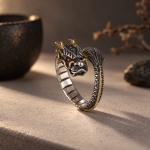
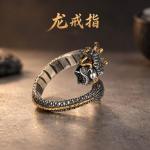
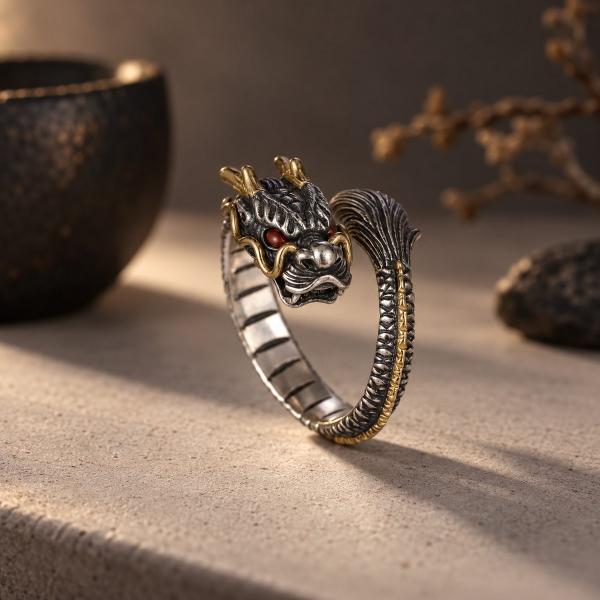
The hard part of a dragon ring is making the dragon coil the whole way round without going stiff. The face of the band is curved, so the body has to travel with that curve and the scales have to deform as the surface turns. Force a flat pattern onto it and everything bunches at the flanks. On a good band, any angle you turn to shows a complete stretch of dragon body, and the join never cuts the creature's head or tail off. Leaving the join on the inside of the band is the usual solution, with the seam hidden in the palm. The head normally sits at the centre of the face; shift it a little and the whole ring reads crooked.
The old painters described dragons by nine resemblances: horns like a deer's, head like a camel's, eyes like a rabbit's, neck like a snake's, belly like a clam-monster's, scales like a fish's, claws like an eagle's, pads like a tiger's, ears like an ox's. The list is not a checklist for every piece. It is a reminder about proportion: the head cannot be too large, the claws cannot be limp, the body needs rises and falls. Give the head too much of the ring and it becomes a beast-head seal, with none of the dragon left. The claws have to open; held closed, they read as a cat's and the force goes out of the whole thing.
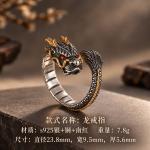
S925 silver sits between fine silver and an alloy on hardness, which is what a ring wants: too soft and it deforms, too hard and it will not carve. Here the scales are in shallow relief, with the recesses darkened and the highlights polished, so the light moves as the wrist turns. It wears better than full high relief and does not snag a sweater. Scale direction has to be consistent; reversed, it looks disordered, and packed too densely it also looks disordered. Empty space is part of the work. The polish should be even, because one bright patch beside a dull one looks cheap.
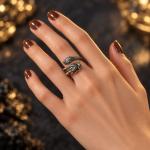
Measure the ring size over the knuckle, not at the base of the finger. Fingers swell in summer and shrink in winter, and half a size either way is ordinary. A wide face makes a short finger look shorter, so a narrower band suits a slender hand; thick knuckles need a band that isn't too heavy, or it will jam going on and coming off. Measure with a narrow strip of paper around the knuckle rather than a ready-made ring gauge, which often will not pass over the joint.
Worn long, the inside of a silver ring polishes bright while the recesses outside go dark, and that contrast is characteristic of the metal. Take it off for bathing; hot springs and pool water are unkind to silver. When it isn't being worn, dry it, bag it, and keep it away from keys. Once a band has been stretched it is very hard to bring back, so better half a size large than forced on, and sleeping in it will deform it overnight. A polishing cloth leaves black residue on the metal; that is oxide, not silver.