


Menu
By theme
By theme





{{ variable.name }} : {{ variable.values[selectedVariantsIndex[variable_index]].name }}
Quantity:
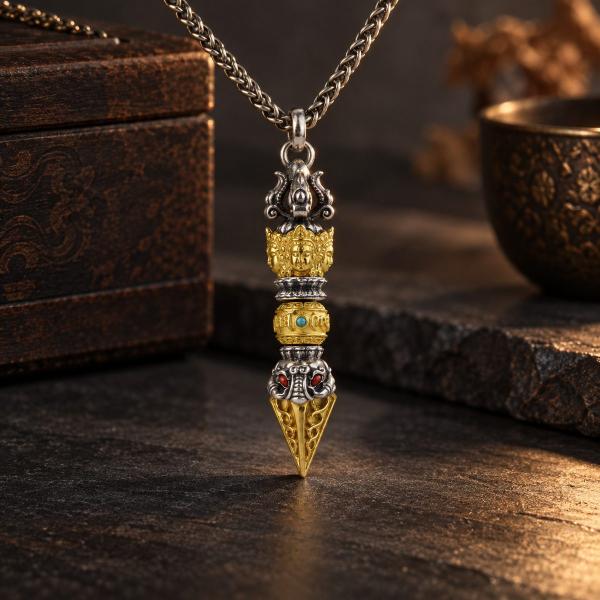
Guanyin and the vajra on one piece is not a common pairing. The vajra is an esoteric ritual implement, descended from an ancient Indian weapon and later carried in practice, standing for what is indestructible. It comes in one, three, five and nine prongs; the central prong is the principal one and the flanking prongs curve in to meet it. The five-prong form is the strictest about symmetry: the four outer prongs must be the same length and their curves identical. The centre prong is thickest, and the ends have to be finished cleanly.
The pendant sets the vajra upright, with Guanyin at its upper end or on the back. The arrangement is deliberate: the vajra is a protective object and Guanyin a compassionate figure, one hard and one soft, so wearing them together doesn't read as aggressive. Reverse it and a wrathful figure on a vajra also works, but it draws the eye in daily wear, and the shop took the safer route. Usually one end of the vajra tapers to a point and the other is left flat, with the flat end carrying the chain so the balance holds. Where the back is flat, the side against the skin is left uncarved. Guanyin can be placed on the front or the reverse.
Cutting a vajra in S925 silver is difficult because of the gaps between the prongs. The gaps must be open, not blurred into a solid mass, or from a distance the piece is just a column. Silver is ductile enough to draw the slender prongs, but they bend if knocked, so keep the pendant away from bag straps and car doors. The inner faces of the prongs are the hardest to polish, since light does not reach them; if the inside is bright, the polishing was done properly. Don't straighten a bent prong yourself. Silver has a memory, and every bend leaves it softer.
The pendant has weight, so the chain has to carry it. A fine O-link chain stretches under a heavy pendant; a box chain is stronger but wears at the joints. The most stable length ends just above the chest; longer and the pendant swings and knocks. If the bail is small, add a transition ring when changing chains rather than forcing a thick chain through it, and choose a lobster clasp, since a spring ring eventually stops opening.
Once silver oxidises, the recesses of the vajra darken first, which actually makes it look more three-dimensional. To keep it bright, wipe in one direction with a polishing cloth, and skip the ultrasonic cleaner, because moisture trapped in the gaps never comes out. If you are sensitive to nickel, check the material of any chain you buy separately. Point down is the conventional way to hang a vajra; point up is not wrong, it is a matter of habit, but don't hang it on a key ring, where one knock will bend it. Wipe it before storing it, and never put it away damp.