


Menu
By theme
By theme


{{ variable.name }} : {{ variable.values[selectedVariantsIndex[variable_index]].name }}
Quantity:
The nine characters lin, bing, dou, zhe, jie, zhen, lie, qian, xing come from Ge Hong's Baopuzi, in the Inner Chapters, in the Dengshe chapter on entering mountains and fording rivers. The original reads lin bing dou zhe, jie zhen lie qian xing, and it was recited on going into the mountains to keep harm away. Esoteric Buddhism later took the phrase up, matched it to hand seals, and it became the nine-syllable mantra. The two traditions went their own ways: the characters are the same nine, the use is not. Among them, dou and zhen are the ones most easily distorted, since the extra strokes crowd together. The original punctuation and the later reading also differ, a point usually overlooked.
The nine are set in a single column, or run in a circle. The count is fixed but the phrasing breaks in several ways. In Japan it is read as kuji, and the ninja hand seals come from there, having parted company with Chinese usage. Chinese-made ornaments usually run vertically, read from the top down, with the final xing centred. There is no need to recite aloud; running through it mentally is enough. Horizontal and vertical layouts are two different treatments, and this piece is vertical. Read downward, not upward, and note that the Japanese line orders the characters a little differently.
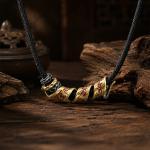
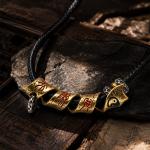
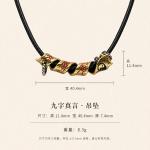
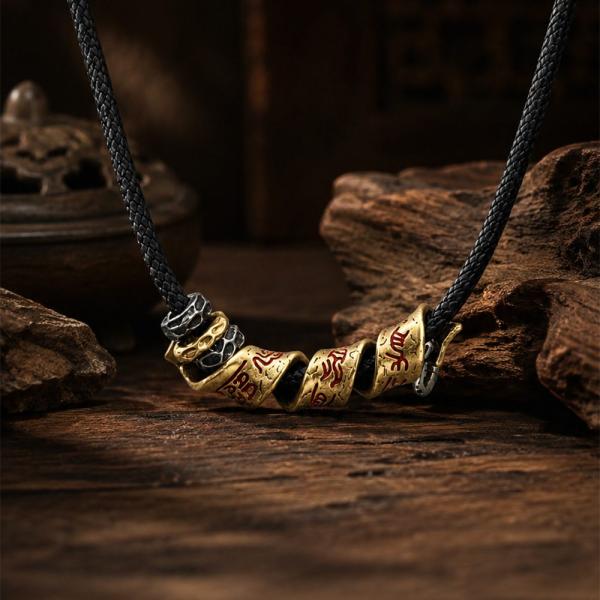
The pendant is antiqued, with the lettering pressed deep, the ground darkened and the face of each character left pale. White copper is antiqued by oxidation rather than coating, so it settles naturally with wear and will not peel off in sheets the way paint does. The drawback is that the black in the recesses fades gradually and has to be fed back; if it won't come back, the piece has to go to the workshop. The finish dislikes sweaty hands: six months on a damp palm and the colour goes patchy, with the corners brightening first.
The silver and gold versions differ in colour. The silver is cool and looks spare against dark clothing; the gold is warm and suits off-white and camel. Both are white copper, and the gold one is plated, so worn edges will eventually show the base metal, which is worth knowing in advance. Plating is thinnest on the corners rather than the flats, and the colour is yellowish rather than the warmth of solid gold. Colour retention depends on plating thickness, not on how often you wipe it.
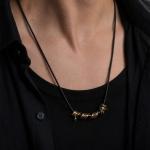
The pendant is not thick, so it sits comfortably against the chest. Choose a shorter chain, because the characters are small and hang too low and nobody can read them. Take it off for bathing: soap getting into the antiqued recesses dries into white spots. Don't dig dust out of the strokes with a needle, which leaves a scratch every time. If the back is blank, a single character can be engraved to order, so decide before it is cut, because it cannot be undone. Avoid versions with shallow lettering, which go flat within six months.