


Menu
By theme
By theme

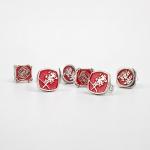
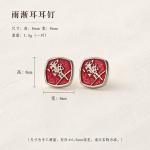
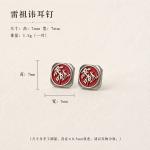
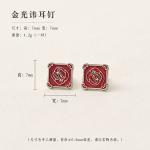
{{ variable.name }} : {{ variable.values[selectedVariantsIndex[variable_index]].name }}
Quantity:
Once the enamel kiln is open, you find out at once whether the colour has lived or died. Enamel powder is packed into recesses cut in the metal and fired. The step cannot be rushed: each firing shrinks the enamel, so full colour needs two or three fills, and over-firing cracks it while under-firing leaves it dull. Earrings are small enough that one pass usually does, but the colour is harder to even, and a slight difference in thickness within one recess fires out as one dark side and one pale. Metal oxides give the colour: copper for green, iron for brown, gold for red, which is the most expensive. Cloisonné uses the technique extensively; small pieces are a different set of problems.
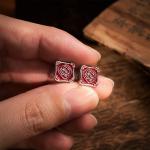
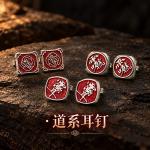
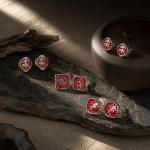
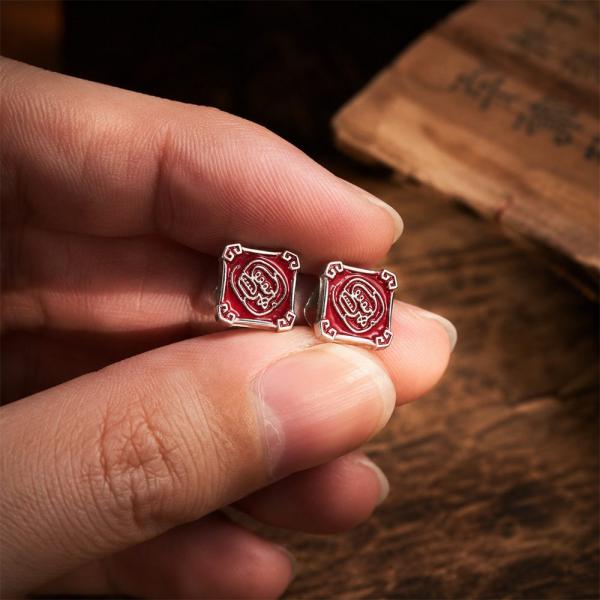
All three designs are characters: the Leizu hui, the Golden Light seal script and the Ziwei hui. Putting talisman characters into enamel is difficult because the strokes are too fine, and enamel will not fill a narrow channel, so small pieces like these thicken the strokes or keep only the skeleton of the character. The skeleton is enough for anyone who knows the character to recognise it, and a complete set of strokes is simply not achievable. Which strokes are kept varies from workshop to workshop, so judge by whether the whole face sits level. The simpler the character, the more it asks of the eye. Where the lettering is shallow, the colour will not stay put.
With a white copper base and an enamel face, the two materials expand at different rates, and cycles of heat and cold tend to open hairline cracks at the edges. Don't bathe in them: a shock of hot water widens a crack. Cracks begin like a hair and are invisible unless you look closely, and by the time you can see one it cannot be repaired. Enamel also chips, and a chip cannot be filled or colour-matched. Taking the earrings off before a shower is the cheapest way to extend their life.
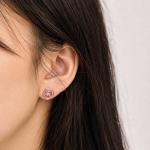
Earrings have to be light. Enamel over metal, made thick, drags the lobe down and becomes uncomfortable within a day. These are made thin, so even a slight lobe can carry them. Silicone backs hold better than metal ones; metal backs loosen with wear, and a loose back means a lost earring, so a spare pair is worth having. Where the back of the stud is flat, the side against the lobe should be polished, or it will rub the skin. A thick lobe under a flat piece tends to make it flip.
Check the post material. White copper posts can provoke allergies, so anyone sensitive should choose silver posts. Among the three, the Golden Light seal script is the brightest in colour, the Ziwei hui the darkest, and the Leizu hui sits between them, which is the order to choose clothes by. Don't wear them in a fresh piercing; wait until it has healed. Left and right of the same pair can differ slightly in colour, which is unavoidable with kiln work.