


Menu
By theme
By theme

{{ variable.name }} : {{ variable.values[selectedVariantsIndex[variable_index]].name }}
Quantity:
The Mountain Ghost comes from Qu Yuan's Nine Songs. She is a deity of the mountains, dressed in fig leaves and girdled with dodder, riding a red leopard with striped wildcats following. The original is beautiful and lonely at once, and its closing line, thinking of my lord and grieving to no purpose, turns a god into someone waiting. The Mountain Ghost of the Nine Songs is a god and not a ghost, though the name misleads. Religion in Chu was close to human feeling. Qu Yuan writes gods in a human key, and the red leopard and the wildcats are animals of the Chu forests.
Later Mountain Ghost charm coins borrowed the name. Charm coins were never currency; they were cast to be worn and to guard a house, one side carrying the Mountain Ghost and Thunder Duke invocation, the other the bagua, and Ming and Qing copies are extremely numerous. Originals are rare, and most pieces are later recasts with soft lettering and uneven rims. Charm coins are a mixed category, covering auspicious phrases, the zodiac, the bagua and talismans, and the Mountain Ghost is one branch of it. What such objects offer is a meaning rather than antiquarian value. The Qing produced the most copies, and what circulates now descends from that wave.
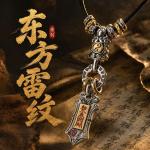
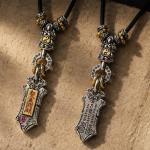
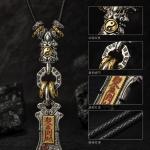
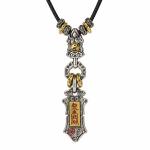
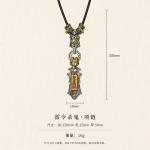
This piece turns the talisman into the shape of a sword. In Daoist practice the sword cuts down evil, and a talisman written on the blade has to run along the ridge rather than across the edge, which would visually cut the sword in two. The guard is left blank so that it reads as a sword and not as a plaque. It does not need many characters: set vertically with tight spacing, it looks edged. The edge is not sharpened, since safety comes first. The ridge is a single line, and if it wanders the whole shape falls apart. Blade thickness should be even; uneven, and the light goes wrong.
White copper sword pendants tend to be thin, and the edges should be chamfered or they dig into the hand. After antiquing, the bright ridge against the dark blade draws a line, and from a distance the piece looks sharp. The point is the thinnest part and dents if dropped, and a dent is hard to repair. This one is of medium thickness and does not drag in daily wear; don't pair it with too heavy a chain. Keep silver dip away from an antiqued blade. A fine chain keeps the sword from looking ponderous.
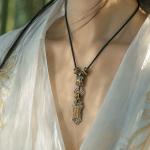
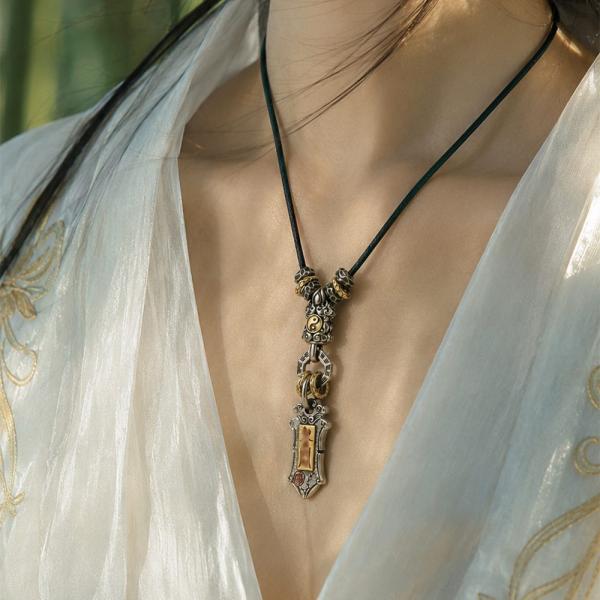
Hang it with the point down, which is the old rule. Don't make the chain too long: the sword has a direction, chest length is enough, and beyond that the proportion goes. Copper dislikes sweat and perfume, so wipe it after wearing. A sword shape presses against the skin, and over thin clothing it is more comfortable outside the fabric. Use a dark cord, because a pale one cannot hold the antiqued copper.