


Menu
By theme
By theme

{{ variable.name }} : {{ variable.values[selectedVariantsIndex[variable_index]].name }}
Quantity:
Five mountains crowded onto one pendant, and the first problem is hierarchy. The Five Peaks are Mount Tai in the east, Mount Hua in the west, the southern Mount Heng and the northern Mount Heng and Mount Song at the centre. The old Chinese treated the five as five supports holding up the world; emperors went to Tai to perform the feng and shan sacrifices, while popular blessing simply names all five together. The names already appear in the Erya, and successive dynasties kept lengthening the honorific titles. They are ordered by direction, east, west, south, north and centre, though old books also give other arrangements.
Daoism has a True Form Chart of the Five Peaks, which draws the lie of the five mountains as a talisman diagram and was said to be worn on entering the mountains so that the local spirits dared not come near. The chart circulated for a long time, in woodblock prints and on bronze plaques. The mountain forms on it are not realistic maps: the topography is pressed into the shape of talisman script, and the versions differ, with later woodblocks looking more like landscape painting. Wearing the chart into the mountains is an old belief; nowadays it is read as a pattern.
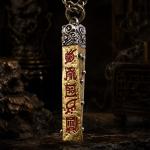
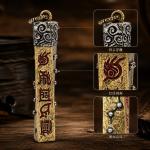
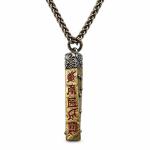
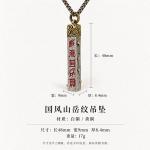
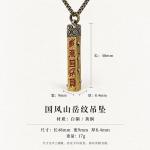
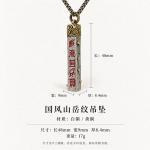
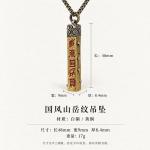
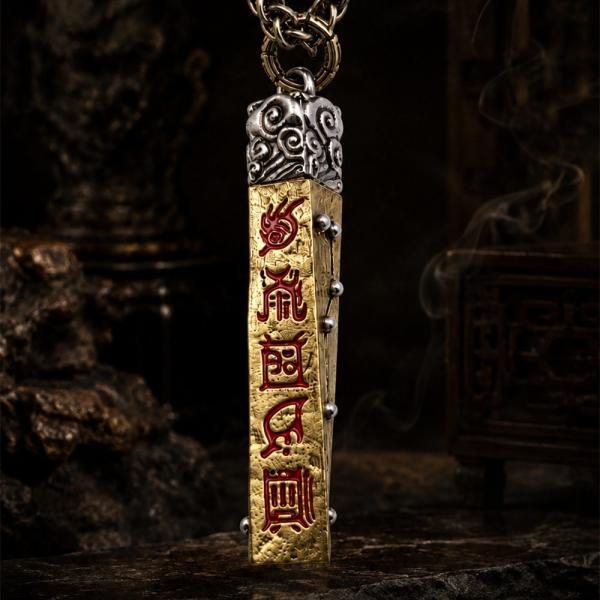
One side of the pendant carries the five peaks, the other qiankun and the character fu. Qiankun means heaven and earth, and fu is the most direct of folk wishes. The two faces carry different information, so the piece can be turned to show whichever you want that day. The fu should hang upright; don't copy the upside-down fu used on doors, because inverted it no longer reads. Qiankun in the Yi Jing are two hexagrams, not simply the words for heaven and earth. The carving on both faces should be of even depth; one deep and one shallow and they stop looking like a pair.
The white copper is antiqued, and both the lettering and the mountain forms depend on shadow. If the five peaks are all cut with the same pointed summit, there is no telling them apart; here the outlines differ in height, Tai steady and Hua steep, and they can just about be recognised. Set side by side, the peaks need differences of height rather than one level line. The ground of the lettering should be flat, since uneven ground collects dust. Old books differ slightly on the placing of the five. Rubbings show the relative heights most clearly.
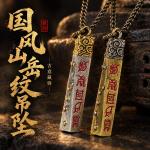
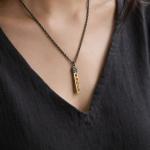
The four options are gold and silver, each on a necklace or as a pendant alone. The gold is plated and will wear through with time; the silver ages better. Plating is thinnest inside the lettering, so wipe around it rather than across. The pendant covers a fair area, and a crew-neck sweater will press against it, so a V neck suits it better; a chain of forty to fifty centimetres puts the face just above the chest. It is not light, so choose a solid chain. The gold version will lose its colour sooner or later.