


Menu
By theme
By theme

{{ variable.name }} : {{ variable.values[selectedVariantsIndex[variable_index]].name }}
Quantity:
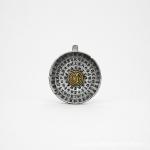
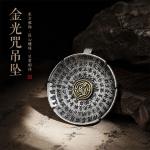
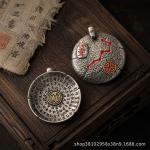
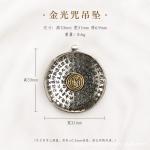
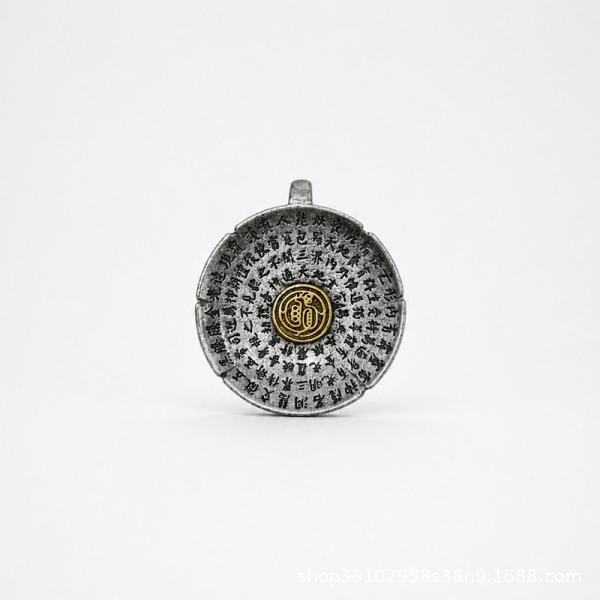
This pendant sets a whole passage of scripture across its face. The characters run in vertical columns, top to bottom, the line spacing pressed tight, and because the white copper ground is pale, the dark held inside the cuts throws the strokes forward. From a distance it reads as a dense field of vertical lines; up close the characters separate out. The cuts are shallow, with a faint drag under the finger, nothing that catches skin. No extra ornament was added. A plain border runs the perimeter and frames the text at the centre, and that is what keeps the weight of the piece settled.
The Golden Light Spell sits near the front of the daily Daoist recitation. It opens with “Heaven and Earth are the mysterious origin, the ten thousand qi are the root,” and goes on, “widely cultivated through ten thousand kalpas, witness my divine power.” The instruction is to make each character clear and never to hurry. Those who teach it say the first lesson is not speed but slowness, holding one phrase at a time until the mind goes quiet — only then has the recitation landed. Most of the lines fall into four-character beats, which gives them a pulse, and that is much of why they are easy to keep.
A text plaque fails in two ways: the characters crowd, or the rim runs thin. Crowd them and the strokes run together into one mass that smears after two months of wear; thin the rim and a single knock takes a chip out of it. Leaving a border is standard in traditional plaque work, half of it composition, half of it giving the polishing wheel somewhere to work — with that plain ring in place, the abrasive never rounds the mouths of the cuts. The engraving is cut with a travelling graver, pushed stroke by stroke, which is what leaves small differences in depth. Stamped characters sit at one depth throughout and look flat.
The three options differ only in the fittings. The pendant alone suits anyone who already owns a chain and likes to swap things around. The rosewood cord is dark, and against the cold white of the copper it reads as one deep tone against one bright one; the cord adjusts, so it sits close to the neck. The version with a chain arrives ready to wear, which is the least trouble. On a slim neck the cord lies flatter; a chain hangs with more weight and drops the pendant a little below the collarbone. Over time the rosewood cord takes on a patina and shifts toward red, ageing alongside the metal. That change comes slowly.
White copper darkens with wear, most obviously in summer sweat, when the face fogs over. Press it with a dry cloth; skip the wet wipes, whose contents will blotch the colour. When dust collects in the cuts, brush it dry with a soft toothbrush, following the direction of the strokes, and it comes out in a few passes. Put it back in its pouch when you are not wearing it, and keep it out of a pocket shared with keys. A thin layer of oxidation on the metal actually sets the characters off, so there is no need to polish it to a shine.