


Menu
By theme
By theme


{{ variable.name }} : {{ variable.values[selectedVariantsIndex[variable_index]].name }}
Quantity:
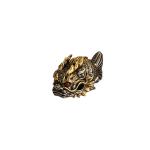
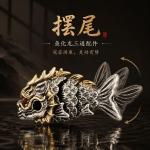
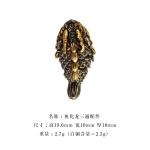
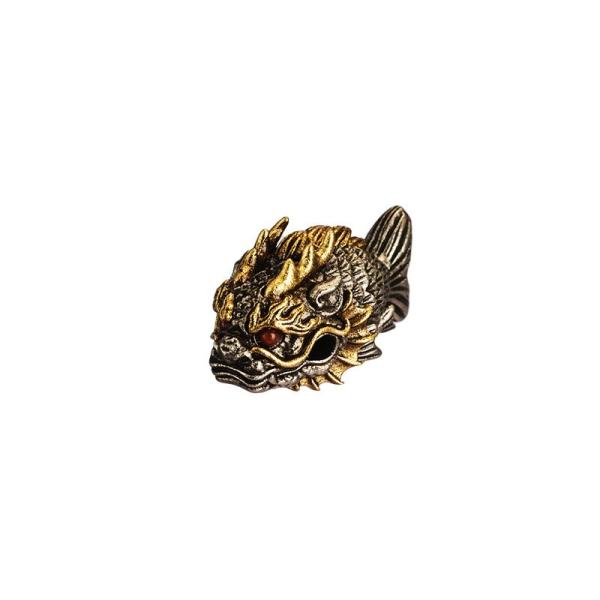
The dragon head on a fish-dragon grew there late. The old record San Qin Ji describes the carp below the Dragon Gate: those that leap it become dragons, those that fail fall back. So the phrase “fish and dragon transform” is very old, and by the Song dynasty it was already a painting subject. In the motif the fish head has usually begun to change, horns grown and barbels sprouting, while the body is still a fish and the tail still forked. The transformation is caught mid-way. Not finished. It is also why the tail is still a fish's tail.
That mid-way moment is a nuisance to carve. The scales have to run all the way up to the neck, and above the neck they become dragon mane, so the two textures must meet and hold. A clumsy join leaves a broken ring of line at the throat. A good one lets the scales grow larger and thinner as they climb, fading into a few strands of mane until you cannot point to the boundary. Look at that section of neck and see whether the transition is gradual. If it is, the work is there.
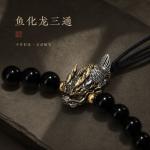
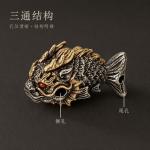
The holes run at right angles in three directions, and a motif with a direction to it wants the head up and the tail down. String it the other way and the whole strand feels as though it is sagging. There is no fixed rule about this, but most people who string will set it that way. The tail side is normally left facing the pendant below, where the fork of the tail catches the cord and keeps it from twisting out of line.
White copper is hard enough for the holes to be cut clean, without burrs. Burrs are the worst nuisance in stringing. The cord wears a little every day, invisibly, and by the time you notice, the surface has gone furry. When a piece arrives, pull a cotton thread through the holes twice and feel whether it catches. If the junction where the three holes meet has a step inside it, the cord will jam there, so run a fingertip around that too. A clean hole is worth more than a pretty surface, because you feel it every time you string the piece.
For pairing, the fish-dragon is best with plain beads. Beads with their own pattern steal the scene. Dark wood, coconut shell and lapis all work, and the blue of lapis against cold white is very clean. Thread an empty cord through first and make sure it runs, then add the beads, so you are not taking the strand apart twice. The edge of the tail is thin and will curl if knocked, so do not rest the piece on it when storing. The body runs across the bead, so avoid long barrel shapes; flat beads break up the line.