


Menu
By theme
By theme



{{ variable.name }} : {{ variable.values[selectedVariantsIndex[variable_index]].name }}
Quantity:
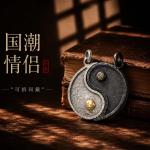
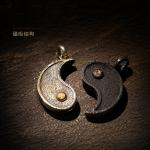
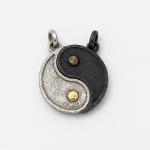
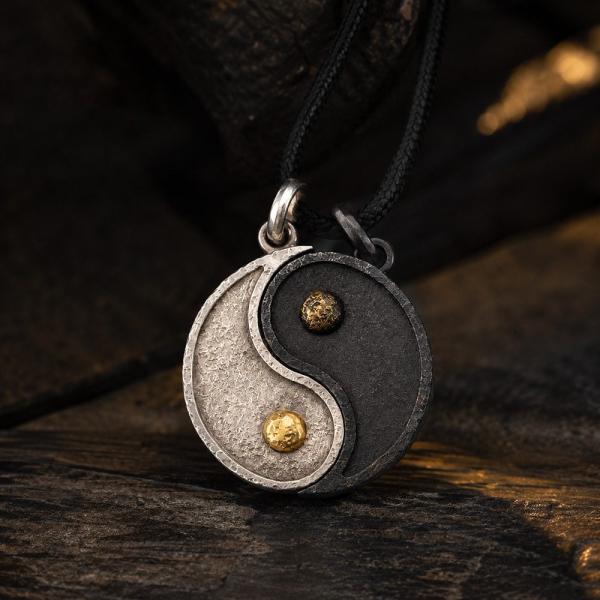
The yin-yang fish looks ancient, but the figure settled late. Pre-Qin texts discuss yin and yang as qi and the seasons, without this diagram; the drawing of two fish, black and white, curled into a circle, only becomes common in Yijing diagrams from the Song and Yuan, and by the Ming and Qing it is everywhere on objects. The white fish carries a black dot and the black fish a white one: yang inside yin, yin inside yang, nothing purely one thing.
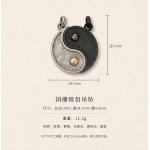
The couple’s version is a pair, identical in design, one each. The guochao palette has been popular for a few years now; red, black and gold laid on white copper read more distinctly than plain metal colour. Set side by side they make a complete pair; worn separately each stands on its own, which is the basic requirement for this kind of design. Given as a gift, one goes to the other person and one stays with you, which says more than buying two of the same thing.
Three options: with a cloud cord, pendant alone, or with a chain. The cloud cord is the more traditional choice, adjustable, and it works with both round and stand collars. A chain is more everyday and holds its own under a shirt or a knit. The pendant alone is for anyone who already has the hardware. The hole is at the top, so it can be worn either face out; the back is flat and does not dig into skin, and the edges have been rounded so there is no thin-blade feel. On a plain shirt the flat back lies still; on a cord it shifts a little more freely, which some people prefer.
Taiji and bagua often appear together, though they are two different systems. Taiji is about origin; bagua is about division — qian, dui, li, zhen, xun, kan, gen, kun, eight figures of three lines each, a solid line for yang and a broken one for yin. The earlier and later arrangements differ, and when the sequence changes the directions change with it. This pendant takes taiji as its subject and treats it as a totem, dropping the fine trigram lines and keeping only the turning outline. With the trigrams gone the face is clean and the eye goes straight to the circle.
The one risk with a white copper taiji plaque is a fingernail dug into the seam between the two fish. That curved division is the finest line on the piece, and picking at it raises burrs. Clean with a soft cloth; work the seam dry with a cotton bud. Store it separately rather than stacked with other metal — two plaques rubbing together always damage the thin line first. A pouch of its own costs nothing and saves the edge.