


Menu
By theme
By theme



{{ variable.name }} : {{ variable.values[selectedVariantsIndex[variable_index]].name }}
Quantity:
The Four Symbols are the guardian creatures of the four directions: Azure Dragon in the east, White Tiger in the west, Vermilion Bird in the south, Black Tortoise in the north. The Black Tortoise is a tortoise and a snake combined, the snake coiled over the shell, and that image was fixed as early as the Han. The old astronomers split the twenty-eight lunar mansions into four groups of seven, each group with its creature, which is how a region of sky acquired a direction and a colour on the ground. East belongs to wood and is blue-green; west to metal and white; south to fire and vermilion; north to water and black.
The four are always arranged the same way: Azure Dragon left, White Tiger right, Vermilion Bird front, Black Tortoise behind. That order is visible on Han palaces, tombs and roof tiles — the four-god tile being the obvious case, one creature to a tile, four to a set, nailed along the eave. On a small piece, when all four share a plaque, they usually follow the same scheme: east on the left, west on the right, south at the top, north at the bottom. Whether a maker knows the material shows first in whether those four positions are right.
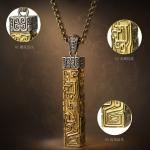
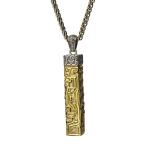
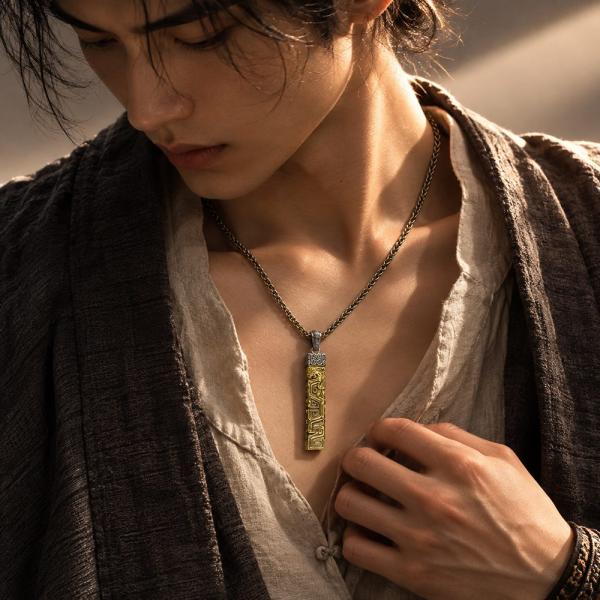
The pendant and the necklace differ in the fitting. The pendant alone is for anyone who already has a cord, and a thick cord is what a fully worked plaque like this needs. The necklace comes on a fine chain, which suits a lower neckline. The piece has weight, and too fine a chain will pull forward and stretch over time — worth thinking about when you choose. With this much carving on the face, a cord holds it steadier than a chain; the thicker cord keeps the plaque from turning over.
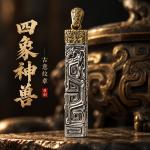
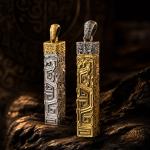
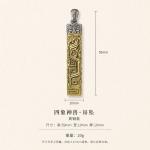
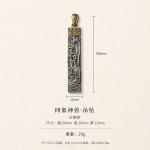
This one is antiqued white copper, the beasts raised on the face, high points polished bright, hollows left dark. Depth of antiquing is where the work shows: too little and it looks dirty, too much and it looks smeared; even is what matters. The four creatures are drawn with dense line — scales, feathers, the pattern on the tortoise shell all have to fit inside a limited area, and where it cannot be read clearly it is simplified. Simplified is not the same as fudged; the outline still has to hold. Two versions, gold and silver: one leans warm and old, one cool. Preference decides.
On an antiqued piece the dark in the hollows is part of the finish, so do not go at it with a brush. A dry cloth pressed over it day to day; once or twice a year, a soft cloth with the smallest amount of brass polish, raised surfaces only. Dust collects worst in the seams between scales; brush it out dry with a soft brush, following the pattern. Store it in its own pouch — a fully worked plaque is the kind of thing that chips, and one knock leaves a bright white point.