


Menu
By theme
By theme




{{ variable.name }} : {{ variable.values[selectedVariantsIndex[variable_index]].name }}
Quantity:
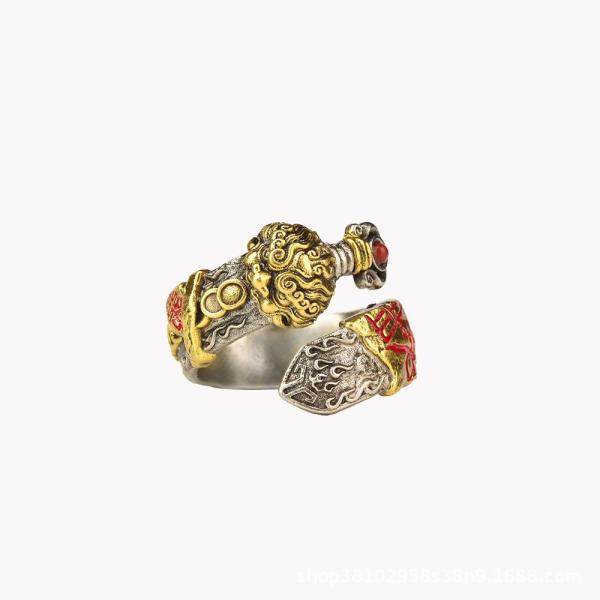
In Daoist practice a sword is a ritual instrument, not a weapon. The ritual sword has a narrow blade, a plain guard and a bound hilt, and the point of it is direction: wherever it points, the qi goes. The seven-star sword in folk painting carries seven dots along the blade, one for each star of the Dipper. Reduced to a ring bezel, a sword can only be a silhouette — tip, guard, pommel, three places kept crisp, the section between them simplified. Proportion is the hard part: too long a blade and it looks like a needle, too short and it looks like a leaf, and you try again and again inside the width of a knuckle.
The phrase ji ji ru lü ling begins in Han dynasty official documents. Edicts and military proclamations often closed with ru lü ling — carry it out according to statute, without delay. Daoism later took the formula into its incantations and prefixed ji ji to sharpen the tone. People who recite it may never have wondered where it came from, but the cadence of a government order is still in it: hard, short, no room left. Four characters, clipped and flat, and that is the effect wanted — an order, not a prayer.
The ring is open, with the sword bezel sitting above the gap. The usual way to wear it is point toward the fingertip, which reads as forward; some turn it the other way, point toward the back of the hand, whichever looks right to them. The open side allows half a size of adjustment, but do not treat it as a hinge; bend it repeatedly and the joint under the guard is the first thing to fail.
White copper’s cold white suits a sword. A warm metal makes the form look soft; only a cool one holds it up. The bezel is polished to a middle brightness, not a mirror, so the light on it draws a narrow bright line that does not scatter. The tip is the place that takes knocks — sleeves, pockets, the edge of a bag. Store it separately, not loose in a pocket with keys. Worn face inward there is less to hit, though the shape presses against the pad of the finger and you feel it when you grip something.
Clean daily with a dry cloth, and use a cotton bud in the seams. Dust collects in the inner angle where guard meets blade, and once that goes black the whole silhouette dulls. Take it off when you wash your hands; soap left in the seam dries white. Copper does not need polishing every day — a thin oxide layer actually sharpens the outline, and polishing it bright costs it that bit of age.