


Menu
By theme
By theme




{{ variable.name }} : {{ variable.values[selectedVariantsIndex[variable_index]].name }}
Quantity:
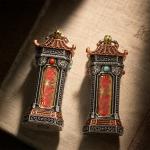
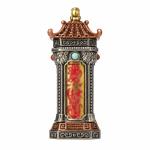
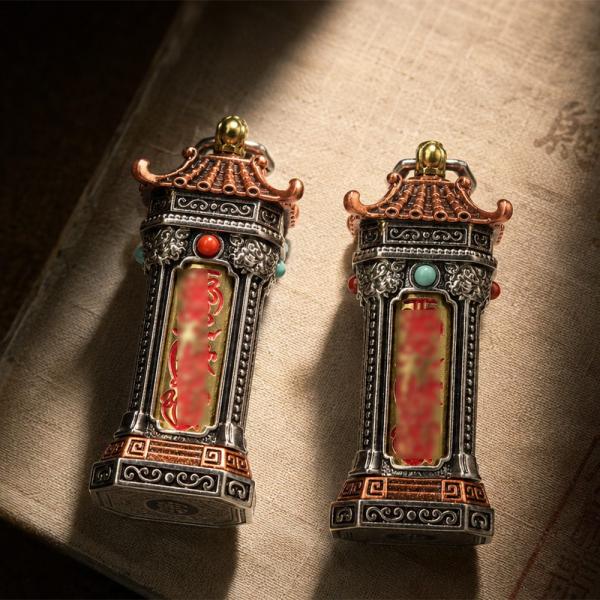
In old Chinese architecture, roof rank is legible at a glance. The hip roof is highest: four slopes, five ridges, the Hall of Supreme Harmony in the Forbidden City being the type. The gable-and-hip roof comes next, with its extra gable triangle; below that, overhanging gable and flush gable. Ordinary viewers read a building’s roof first, and if the roof is right the character is right. Makers of small pieces know this too: on a plaque the hall’s roof has to carry half the weight. Lower the roof and the whole building loses presence and becomes a gatehouse.
A hall is a place for offerings. Inside the gate is the hall, inside the hall is the niche, and inside the niche is the image. Households set the god of wealth at the centre of the main room; those with means build a small hall, those without set up a niche. Different form, same logic: the innermost square is reserved for something you cannot see. Made into a pendant, the piece takes that sense of a door, an entrance you can carry. As for who sits inside, the plaque does not say, and there is no need to assign anyone.
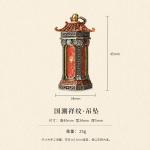
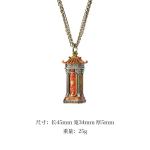
Antiquing gives the building depth. The tile rows run one after another, dark in the channels, bright on the ridges, so from a distance it is a field of fine vertical lines. The door studs are small dots: too many and it goes busy, too few and it goes empty, and they are usually spaced to the proportion of the doors. White copper’s cool tone suits architecture; a warmer colour turns a building into a toy. Single pendant or on a chain are two ways to buy, and this plaque has weight — the chain version needs a slightly heavier chain to hold it, or a fine one will pull forward within two days.
Compressing a hall onto a small plaque is a matter of what to leave out. The frontal perspective has to be tightened, and the eaves cannot be drawn at a true angle or the ends fly up absurdly. The bracket sets must be simplified: a real one has dozens of components, and on a plaque a few squares have to stand in for it. The platform must stay; without a platform the hall appears to float. All of these solutions have precedent in traditional woodblock printing and brick carving — they are not modern inventions. A hall carved in brick is often shown frontally only, the side walls implied with a single diagonal, and the viewer fills in the space.
The architectural lines on the face are dense and collect dust. Brush with a soft brush along the direction of the tile rows; brushing across pushes dust into the seams. Do not pick at the door studs with a fingernail, because it raises burrs. Store it flat and do not stack other plaques on it — the raised lines of the tiles take impressions more easily than anything else on the piece.