


Menu
By theme
By theme


{{ variable.name }} : {{ variable.values[selectedVariantsIndex[variable_index]].name }}
Quantity:
The character hui means to avoid. The ancients did not speak the personal names of elders or rulers: in writing, a stroke was left out; in speech, another word was substituted. The set of rules was called bihui, name avoidance. It was not only etiquette but a boundary of power — who was allowed to say a name and who was not was drawn very clearly. The practice left marks on paper: the “so-and-so” characters and the missing strokes in old books mostly come from this. Daoism took the convention over and applied it to the names of gods.
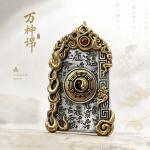
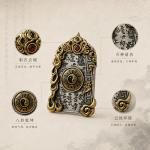
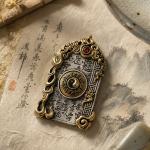
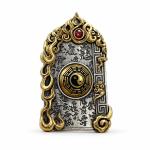
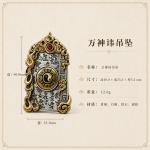
“Myriad deities’ names” is not the name of one god but a row of many taboo characters set together. On the plaque they form a dense field, crossing vertically and horizontally, and looked at long enough they resemble woven texture. The arrangement has its logic: a single character is too small to read, while a whole field becomes a pattern in itself. The wearer does not have to make out each one — knowing it is a stack of names is enough.
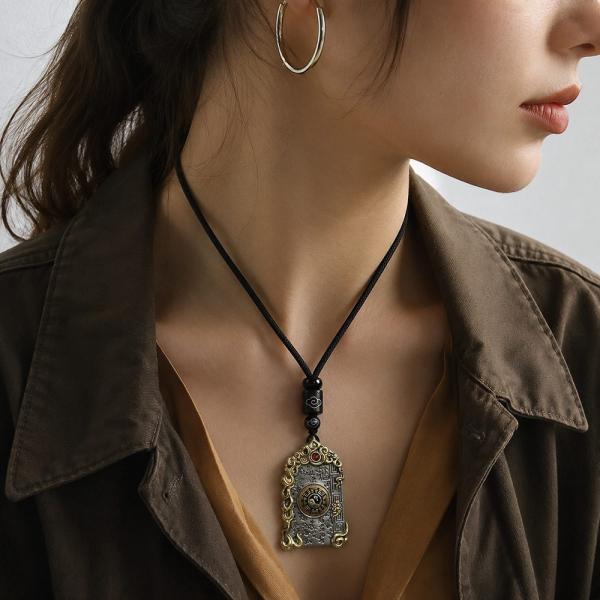
Pendant alone or with a necklace. Alone it takes a cord of your own, and since a name plaque is usually left plain, a dark cord is steadiest. The necklace version comes on a fine chain, sits at the chest, and both faces can be seen. The face is crowded: from a distance a grey haze, up close characters. That effect — texture at a distance, text up close — is the most appealing thing about the subject, and the reason it works as an ornament at all.
In Daoism a divine name is written as a transformed character. Strokes are stacked, radicals shifted out of place, and to an outsider it looks like a knot of ornament with no readable sound. These forms are used mainly on talismans: when drawing one, the name is embedded at a particular point, which gives the talisman its presiding power. The writing is supposed to go in one continuous movement, and where a stroke breaks it has to be picked up again; break it and the whole thing falls apart. Schools differ, and the same god may have different written forms. There is no universal standard.
A fully worked plaque is the kind that collects dust. The strokes are fine and so are the seams, and dust that gets in does not come out easily. Brush dry with a soft brush, following the direction of the strokes, one direction, not back and forth. Do not rinse it: water pushes dust deeper into the seams, and when it dries it sets into a crust. The copper gets a dry cloth pressed over it, not wiped across the characters — once the dark in the cuts is gone, the whole plaque goes flat.