


Menu
By theme
By theme





{{ variable.name }} : {{ variable.values[selectedVariantsIndex[variable_index]].name }}
Quantity:
The names of the seven stars of the Dipper are written plainly in old texts: Tianshu, Tianxuan, Tianji, Tianquan, Yuheng, Kaiyang, Yaoguang. The first four close into the bowl; the last three draw out into the handle. Beside Kaiyang there is a small companion star, Fu, not bright, visible to anyone with good eyes. Conscription physicals in the old days are said to have tested eyesight on it: see Fu, and you passed.
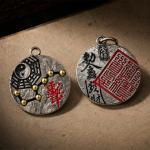
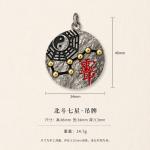
On the plaque the seven dots cannot be placed at random. The four in the bowl should form an irregular square, the three in the handle a line with a slight curve, and the whole should look like a ladle for scooping. Some versions cut the lines joining the dots, some leave the gaps empty; cut lines look precise, open space looks airy. If the plaque is long and narrow, the handle has to be shortened, or the piece stretches into a stick. The dots should not all be the same size either — those at the mouth of the bowl slightly larger, the last of the handle the smallest.
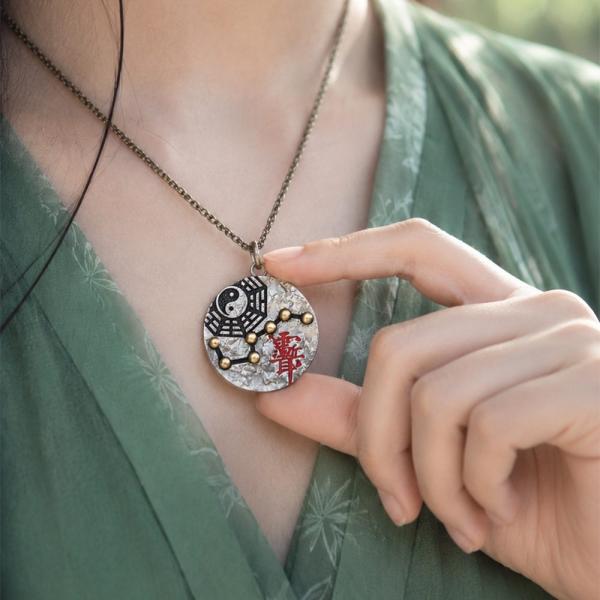
Two kinds, pendant alone or with a necklace. The plaque is longish and hangs vertically at the chest; a cord holds it steadier than a chain, and a thicker cord keeps it from turning side to side. The necklace version comes on a fine chain and holds its own with an open collar or a shirt, the plaque landing at the centre of the chest. If the back is plain it can be worn against skin; if the back is patterned, keep a layer of clothing between. The weight sits in the middle, and since the chain passes through a hole at the top, the pendant hangs straight.
How seriously Daoism took the Dipper shows in an old line: the Southern Dipper records births, the Northern Dipper records deaths. It comes from the story of Guan Lu in Gan Bao’s Record of Searching for Spirits, from the Jin dynasty, and it says the Northern Dipper governs a person’s allotted years. On that account the Dipper has always held a high place in folk belief, and rites of bowing to it and honouring it have been handed down a long time. The Dipper plaque takes that sense, which is not the same thing as astronomical observation.
The lines on a Dipper plaque are fine and the grooves shallow, so once dust settles the whole piece goes grey. Clean with a soft brush, following the direction of the connecting lines. Do not use a toothpick; the point will leave white scratches in the grooves. When the copper dulls, press it with a dry cloth; to brighten it, use polish on the raised faces of the stars only and go around the sunken lines. With the values separated, the seven stars become legible again.