


Menu
By theme
By theme


{{ variable.name }} : {{ variable.values[selectedVariantsIndex[variable_index]].name }}
Quantity:
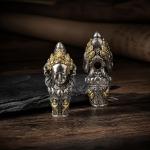
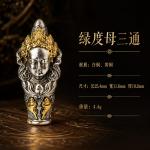
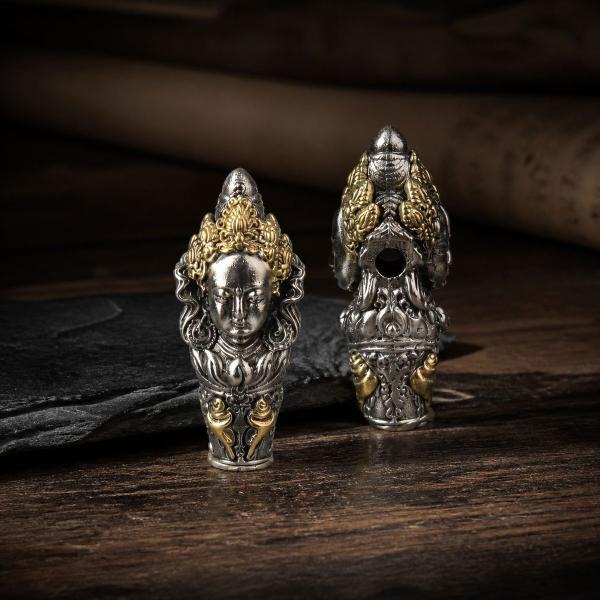
Copper has weight in the hand, and a three-hole bead cut from it never looks cheap. The warm tone of bare copper suits the subject too. Green on a copper ground does not depend on paint; it depends on form, with light running over the curves while the shadowed parts settle by themselves. Make the same piece in bright white metal and the Tara's green has nowhere to land.
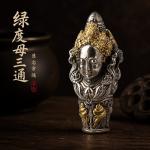
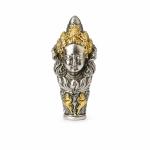
Green Tara is one of the twenty-one Taras of Tibetan Buddhism, and the one most often painted and sculpted in Tibet. Green body, one face, two arms. The right hand rests on the knee with the palm turned outward in the gesture of granting wishes; the left sits at the chest holding the stem of a utpala, which passes between the fingers with the flower opening at the ear. The right leg is slightly extended against the half lotus of the left, a posture that says she is ready to rise. Those features together are Green Tara. Take away the flower and she is easily taken for another Tara.
A full figure on a three-hole bead is a problem of proportion. The face of the bead is only so wide, and once it is split between head, body and lotus seat, the head tends to come out small. Look at the hands. The granting hand needs five separate fingers with the tips down, and if it has blurred into a paddle the mould was never cleaned up. The flower stem is harder still, thin as a thread and passing between the fingers. A good cast shows the bend in the stem. A poor one simply lays the flower flat against the back.
Copper rusts, and it goes green. The green is not entirely a bad thing: down in the hollows it sharpens the pattern, but once it creeps onto the raised surfaces it is dirt. The remedy is a dry soft cloth rather than a soak, because water sits in the holes and will not dry out, and the piece then rusts from the inside. If your hands sweat heavily, wipe it once a day. Copper is a delicate metal in that respect. Leave the salt from sweat on it overnight and by morning you can see the fingerprints.
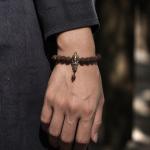
For pairing, Green Tara's green is a cool green and safest against dark beads: ebony, coconut shell, deep blue-green. With warm reds such as coral or southern red agate the colours collide, which comes down to temperament. Use multi-ply cord, since right-angled holes are unkind to elastic. Weight makes itself felt too. Use this as the main bead of a wrist strand and the whole thing hangs a little lower, which is not a fault and which you stop noticing. If it feels heavy, move it to a long strand, where the weight spreads across the neck and shoulders and is, if anything, more comfortable.