


Menu
By theme
By theme







{{ variable.name }} : {{ variable.values[selectedVariantsIndex[variable_index]].name }}
Quantity:
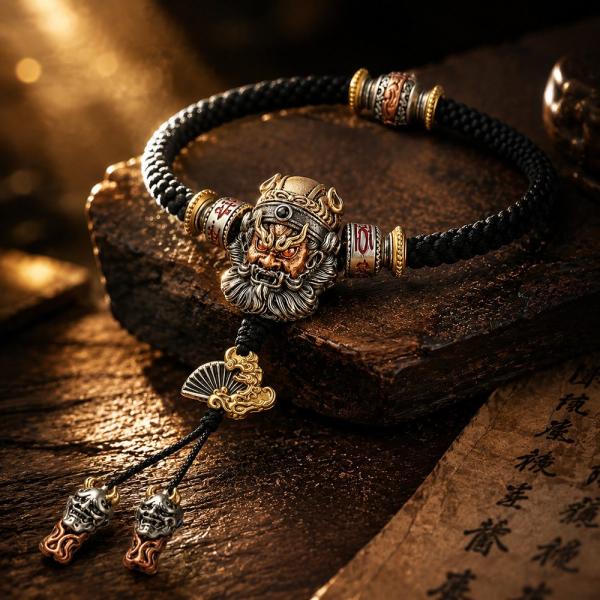
The three-hole bead is the corner in a strand. Beads come along in a line, and here the line splits, two strands down and one up, so the bead has to be a size larger than its neighbours and drilled through in three directions. The size difference is not decoration; it is what makes the turn possible at all. Anyone who strings knows the feeling: choose the wrong one and the balance of the whole strand goes. Top heavy, or shoulders sagging, and however you turn it on the wrist it sits wrong.
If you string it yourself, the order is: settle the main beads, then choose the three-hole bead, then fit the tower. Of its three holes, two run through horizontally and one vertically upward; the cord goes in at the side and out at the top, finishing in a knot. The knot should disappear into the hole — left outside it rubs the neck and looks wrong. Multi-strand cord is best; elastic folds hardest at the right angle of a three-hole bead, and that is where it breaks first. Tie off and tuck the knot inside.
Making Zhong Kui into a three-hole bead is a match of subject and position. The bead is the checkpoint of a strand; Zhong Kui is the figure who stands in a doorway. One governs a turn in structure, the other a turn in atmosphere. Whoever designed it probably thought so too. The correspondence does not need saying out loud — the wearer finding it interesting is enough, and spelling it out turns it into a sales point. The holes have to be aligned; off by a little and the whole strand runs crooked.
Single piece or set. A single is one bead, which suits anyone who already has beads; the set gathers the usual pieces so you do not hunt them one at a time. Not everything in a set gets used, so think first about what your strand actually lacks rather than buying a pile of idle parts for the sake of a set. The advantage of buying singly is that you can build slowly, and stop wherever you stop, which makes it feel more like your own. Neither way is better; what matters is knowing which one you are doing.
The channels through a three-hole bead collect grime; cord rubs inside them and eventually leaves a black powder. When you change the cord, run a cotton bud with a little alcohol through each channel, turn it twice, let it dry, then string. The copper gets a dry cloth and the pattern a soft brush. Zhong Kui’s face is the centre of the piece; do not keep running a finger over it, because the features flatten with handling.