


Menu
By theme
By theme




{{ variable.name }} : {{ variable.values[selectedVariantsIndex[variable_index]].name }}
Quantity:
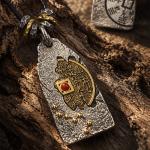
How large would a single tablet have to be to hold all sixty-four hexagrams? The practical answer is to arrange the eight trigrams in a ring and leave the middle for the six lines. The trigrams govern direction; the six lines show movement and change. They were two faces of one system from the start. The surface is only so big, and subtraction is harder than addition: strip a design to its skeleton and it still has to read as the Yi at a glance. That is why most bagua pendants on the market carry one ring of line figures and leave out the sixty-four names, letting the wearer look for them himself.
The term six lines comes from the Yi. The Great Treatise says that the movement of the six lines is the way of the three poles, and the three poles are heaven, earth and man. The lines are counted from the bottom up: the lowest is called chu, the topmost shang, and the four between them are two, three, four and five. A yang line is one unbroken stroke; a yin line is two segments with a gap. Only once six positions are laid out is there anything to say about movement and change. Students of the hexagrams memorize these six positions first, and only then does casting mean anything. There is no shortcut at this step.
On a white copper blank the centre is marked first, then the circle divided into eight equal parts. The chisel travels once around and the trigrams land at the angles they belong to. Line widths must match and the breaks must be clean. One tremor of the hand and the whole tablet loses its composure. The grooves are left dark and the raised faces polished, so the lines only stand up when light rakes across them. The principle is the same as taking a rubbing from a stele: it depends on depth, not on tracing. Polishing is done with a light hand, better to go over the piece several times than to grind at one spot and flatten the figures.
Copper dislikes sweat and dislikes damp. In summer, take the pendant off and press the face with a dry cloth rather than rubbing back and forth, which drags the polished surface into streaks. Dust settles in the bagua grooves. Brush it out dry with a soft brush, following the lines, and a few passes will lift it. When the piece is not worn, keep it in its own pouch; thrown into a pocket with keys, a dent is permanent. Darkening is normal, and that darkness actually makes the incised strokes read more clearly. There is no need to polish it to a mirror.
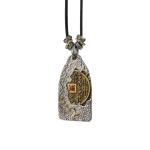
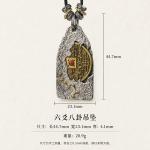
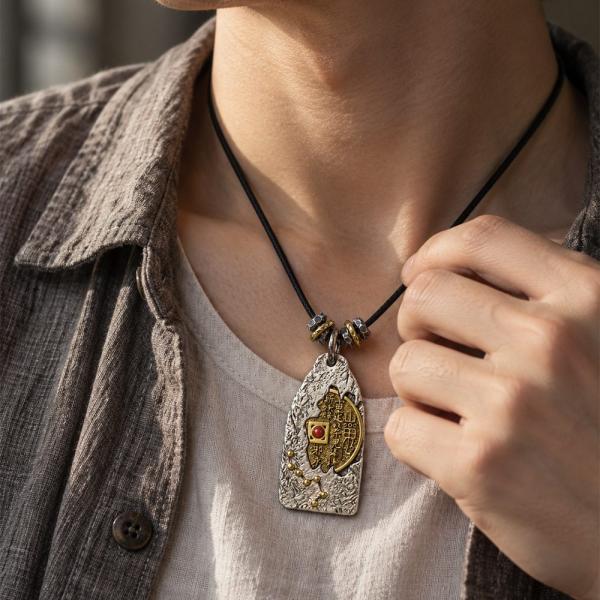
The pendant is sold as a single piece, so anyone who already owns a chain can swap it in. Cord, leather thong and fine chain all pass through. The necklace version comes complete and can be worn straight out of the box, saving the trouble of matching fittings. The hole sits dead centre at the top, so the piece hangs without twisting; on a bagua tablet that matters more than the pattern. The rim has been left with some thickness and rounded, so it feels smooth to the finger, does not cut, and does not snag thread on clothing.