


Menu
By theme
By theme



{{ variable.name }} : {{ variable.values[selectedVariantsIndex[variable_index]].name }}
Quantity:
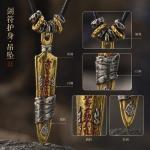
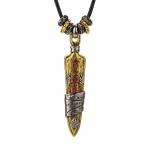
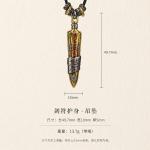
First the sword outline is reduced to a few straight lines; what remains is angles. The sword talisman was originally drawn on paper, with blade, guard and pommel, and a talisman pressed onto the spine. Made into a pendant, the dry-brush strokes of paper cannot be kept, so only the structure is extracted: one central axis, edges tapering in, the talisman portion turned into short horizontals. Whether it has been drawn down cleanly shows at the edge. Fuzzy edges usually mean it was traced from a picture. Done well, it still reads as a sword from a distance without a label.
Daoist ritual uses a ritual sword and also draws sword talismans. The sword ranks near the front among ritual implements, for its straightness and for its cutting. A talisman is treated in Daoist practice as a credential; pressing one into a sword shape means credential and weapon have become a single object. This combined form is common in Ming and Qing folk manuscript books. The drawing methods differ from one hand to another, but the skeleton is much the same. The talisman shapes in those books are mostly simple, and these copper pieces are the ones that kept the simplicity. In folk usage such pendants are also called sword-talisman tablets; the naming is not uniform, but it is the same object.
The advantage of geometry is that it wears well. Too many curves blur at small size, while straight lines and angles stay clear on a pendant. The face is cut with a difference in height: the spine stands a hair proud and the sides drop away, so a fingertip finds that ridge. The back is left flat with no pattern, which is comfortable against the skin. All corners are rounded off. It looks sharp and feels harmless.
The tip chips most easily, so do not let it rest against the wall of the box. Oxidation on copper starts at the edges as a dark line, and wiping should follow one direction. Take it off for showers and swimming. Chlorine pits the copper surface, and those pits cannot be wiped away, only polished off a layer. On the gold version, wear through to the base leaves the colour uneven, which is worth knowing when you wear it.
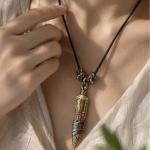
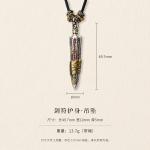
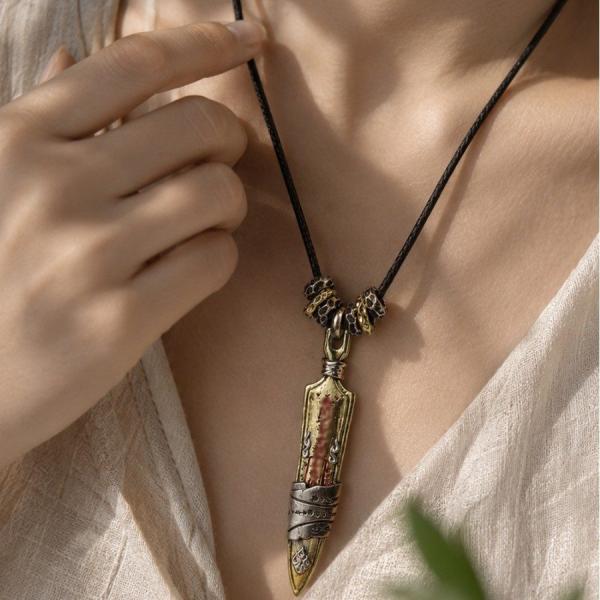
The piece comes only as a necklace, in gold and silver. Gold warms the copper surface; silver stays close to the natural tone of white copper. The chain passes through the hole at the pommel, so the pendant hangs naturally instead of lying sideways. That is one advantage of a sword shape: the weight sits low. The ring hole is polished round, so links turn without scraping and do not wear through easily. Chain length is adjustable, and it looks best at the centre of the chest. The clasp is at the pommel end with the point down, and the direction must not be reversed. The pendant is thin enough to slip into a shirt pocket without digging.