


Menu
By theme
By theme


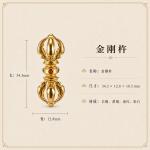
{{ variable.name }} : {{ variable.values[selectedVariantsIndex[variable_index]].name }}
Quantity:
The vajra started life as a weapon. In old Indian myth it is what Indra carries, made of diamond and hard enough to break anything. Buddhism kept the image and turned the meaning around. From something that strikes people, it became an instrument for breaking up affliction. The object is the same stick. The direction it points has changed. Handle one and the first impression is of a tool rather than a charm.
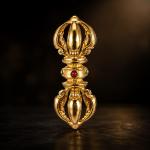
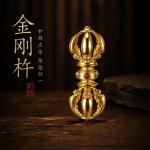
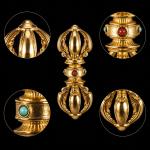
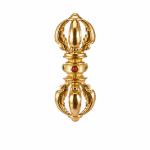
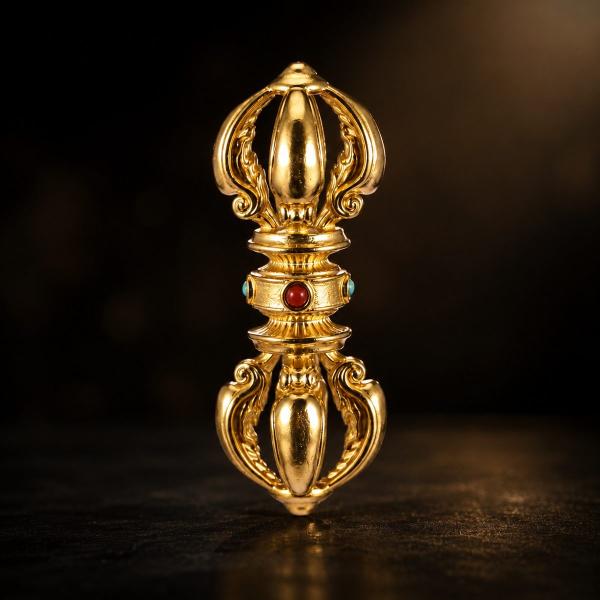
In form there are two heads with a grip between them, and the heads divide into prongs. Three, five and nine all carry a reading. Five stands for the five wisdoms of the five Buddhas, nine for the nine vehicles of teaching, and the more prongs, the more work in the cutting. Small pendants usually take five: one prong at the centre, four at the corners, each rising out of the grip, opening outward and then curling back to hook the central prong. Three prongs is the older form and shows the Indian weapon most plainly. The prongs can be counted at the back as well, since every one of them needs its own starting point in the mould.
In the Tibetan system the vajra is normally paired with a bell. Vajra for method, bell for wisdom, one in each hand during practice. A pendant sold on its own is half of that pair, so look at it knowing the other half is somewhere else. It was always one of two. Not a fragment. That is how the pair is used, how it is stored, and how it is shown.
That hooked structure is the key to judging a piece. Four prongs of the same length, opening at the same angle, with the hook tips aimed at the centre line. Rough work has prongs of uneven length and tips that lean, and the whole thing looks soft in the hand. Lay it flat on a table and look down from directly above the head: the central prong should sit exactly on the four axes of symmetry. A hair off and the eye finds it.
As a fitting it is fussier about holes than as a pendant. The vajra is thick at both ends and thin in the middle, so a hole can only be cut in the grip or at the tip. In the grip, it hangs across the line and swings. Cut at the top, it drops straight. Ask where the hole is before buying; that matters more than the pattern. White copper does not mind sweat but it minds knocks, and the hook tips are the most brittle part. Dropped on a hard floor they chip, and a chip cannot be repaired, so keep it in its own small bag. If one tip is worn round while the other is still square, the piece has been reworked rather than left as cast.