


Menu
By theme
By theme


{{ variable.name }} : {{ variable.values[selectedVariantsIndex[variable_index]].name }}
Quantity:
Everyone can tell the story of the eight immortals crossing the sea, but how many of their attributes can you still name when the objects are set out on their own? The fan belongs to Zhongli Quan, the sword to Lü Dongbin, the gourd to Iron Crutch Li, the jade tablet to Cao Guojiu, the flower basket to Lan Caihe, the lotus to He Xiangu, the flute to Han Xiangzi and the drum to Zhang Guolao. All eight together make a set. Recognizing attributes is harder than recognizing faces: a face is a face, while an attribute is only an outline. Learn these eight and the patterns on old furniture and old porcelain begin to fall into place.
Drawing the objects without the people is called the hidden eight immortals. It is common on Ming and Qing porcelain, brocade and furniture, and its point is restraint: see a gourd and think of Iron Crutch Li, see a sword and think of Lü Dongbin; the figures are left out and the meaning stays. The device was popular in folk art, first because the composition stays clean, and second because it avoids the many conventions that come with painting figures. The jade tablet is sometimes written as the clapper, the two pieces in Cao Guojiu's hand that sound when struck, which is not the same thing as a court tablet.
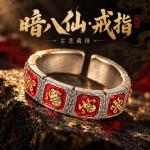
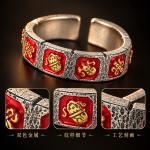
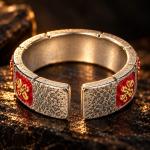
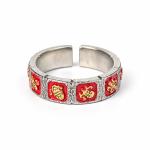
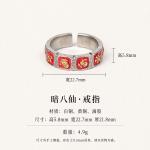
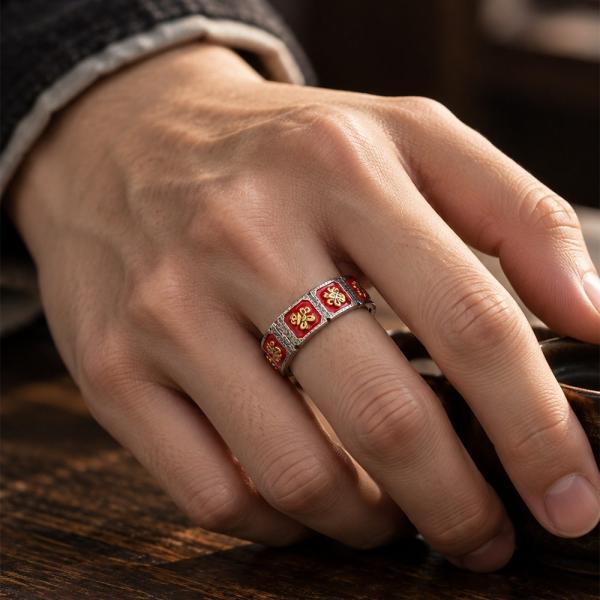
The ring is open, with a gap in the band that springs a little, so it goes on past the side of the knuckle. Where the gap sits varies by maker; the careful ones hide it where the pattern breaks, so that it looks like a gap that was always there. An open ring should not be sprung wide again and again: copper fatigues, and once it loosens it no longer grips. The width of the gap matters as well. Too narrow and it will not spring; too wide and the pattern is cut in half.
The eight attributes run around the face, each only a millimetre or two across, and everything depends on a clear outline. The sword needs its edge, the gourd its waist, the basket its handle; blur the detail and the eight turn into eight lumps. The hardest of the eight are the flower basket and the treasure vase, one needing a handle and the other a narrow neck. Casting in white copper gives this fine pattern more regularity than hand chiselling; mass production wins on consistency and loses the liveliness of the tool mark.
The two ends of the gap are the first place a fingernail wears a bright mark, so hold the band when putting the ring on and taking it off, not the gap. As the copper oxidizes the pattern reads more clearly, the darkness settling into the hollows. To bring the shine back, wipe the raised faces only and leave the recesses dark, since that is what gives the pattern relief. Soap grime between the fingers softens in warm water before brushing. An open ring is not for heavy work: spring it and press it and the circle goes out of shape.