


Menu
By theme
By theme


{{ variable.name }} : {{ variable.values[selectedVariantsIndex[variable_index]].name }}
Quantity:
For a dragon to coil around a ring band, the length of the circuit has to be worked out first. Divide it into head, body and tail, and the body takes the longest arc; two and a half turns bring it neatly to the opening. Coil too little and the body ends halfway; too much and there is nowhere for the head. The same calculation applies to bangles and belt fittings: fix the circumference, divide the segments, and leave the cutting to the last step. The word for coiling here means the body wrapping into a ring, not a dragon lying in a dish.
The coiled-dragon pattern appears very early. Shang and Zhou bronzes carry coiling dragon motifs with the body wound into a circle and the head at the centre; Han jades include coiled dragon pendants with the body in a ring and head and tail touching. The line never broke, and it was still in use on Ming and Qing belt hooks and buckles. The Shuowen defines the dragon as the chief of the scaled creatures, able to be hidden or bright, fine or huge, which describes something with no fixed form; a craftsman may coil it as he likes and not be wrong. A belt hook is only a finger long, and if the dragon is to coil its whole body, the tool has to economize.
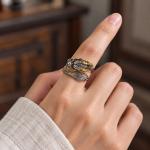
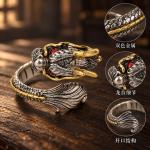
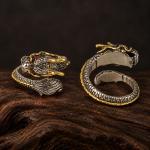
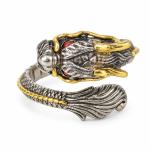
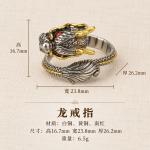
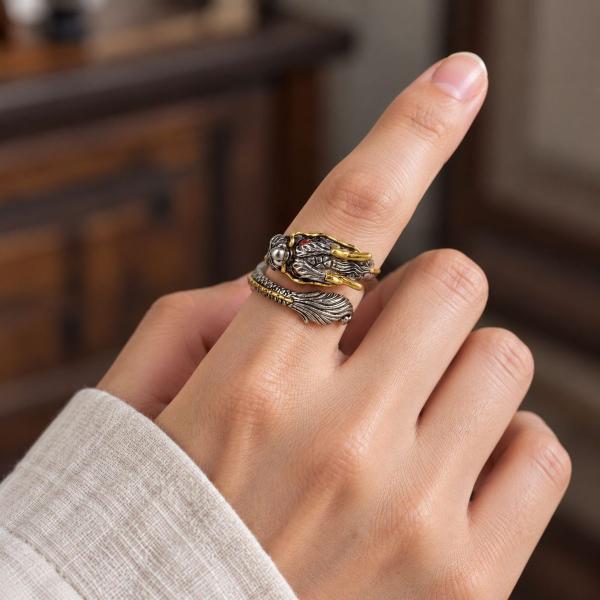
On this ring the head sits at one side of the opening and the body runs around the band, scales overlapping, the spine raised so that a fingertip finds a ridge. The claws are drawn in at the sides rather than spread; spread, they would be a mess at this size. The tail tapers and tucks beneath the head so that it looks as if head and tail meet, though a line is left between them, and that line is the opening. The scales need not be spelled out one by one; skipping a cut every few scales lets the pattern breathe. Whiskers, horns and claws cost the most cuts and chip most easily.
The opening is there so that the ring can be adjusted. Fingers swell and shrink through the day, and when a closed ring will not pass the joint, an open one only needs springing. Spring it the right way: hold the band with both hands and push outward evenly rather than twisting. Twist it often enough and the body section distorts first, because that is the thinnest part. Once adjusted, leave it alone; copper fatigue accumulates.
The scale grooves are shallow, and sweat grime fills them and goes black, so that it looks like an artificial antique finish. To clean it properly, use a soft brush with a little diluted neutral soap and dry it at once. The raised spine line polishes first, and when it goes white the whole ring loses its depth; at that point it needs an overall polish to bring the bright areas back down. Store it on its own when not worn, since claws and horns are sharp and will scratch other things. Keep the dark in the scales and the dragon lives; polish it all bright and it looks like a twist of dough.