


Menu
By theme
By theme

{{ variable.name }} : {{ variable.values[selectedVariantsIndex[variable_index]].name }}
Quantity:
Zhenwu was originally called Xuanwu. Before the Northern Song, both Daoists and the folk used that name: the god of the north among the four images, tortoise and snake combined. The change of character was a Song affair. In the Dazhong Xiangfu era Emperor Zhenzong honoured the Zhao clan ancestor as Sagely Ancestor, whose personal name was Xuanlang, and the whole realm observed the naming taboo: the character xuan could no longer be used, and Xuanwu was written Zhenwu. One character changed with a dynasty, and the god's title changed with it.
Xuanwu corresponds to the seven lunar mansions of the north, the Dipper, Ox, Girl, Emptiness, Rooftop, Encampment and Wall, which together form an image of a tortoise with a snake coiled around it. Watching the night sky, the ancients joined these seven star groups and thought they looked like a tortoise, and like a snake coiled on a tortoise, and so the image arose. Each of the four images governs a direction; the north belongs to water and its colour is black, which is why Zhenwu is usually shown with loose hair and dark robes, treading on tortoise and snake with one hand pressing a sword. Of the four images only Xuanwu is a compound of two creatures, tortoise and snake, one still and one moving.
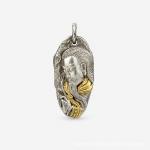
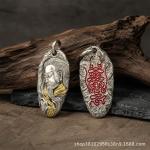
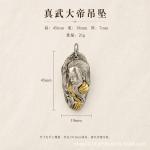
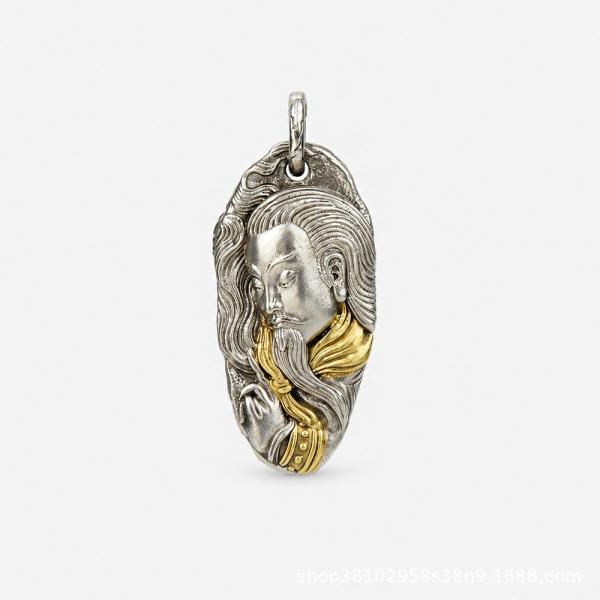
The Zhenwu on the pendant is a half-length figure. The head is slightly lowered, the hair falls to the shoulders, the brows are pressed down, the eyes are not wide and the mouth is closed. The robes are cut with a deep blade, layer over layer, the wide sleeves hanging down and holding the outline of the body. The tortoise and snake beneath his feet show only at the edge; carved in full they would fill the face. The sword lies across the body with the point down, a common treatment for seated figures. The skirt of a seated figure spreads out and takes the lower half of the pendant, its pattern dense, and it is the most laborious part to polish.
The lines of the loose hair are very fine and are the first thing on the whole pendant to wear smooth. Do not run your fingers over them; hold the piece by the edge when taking it off. Once the copper darkens, the hairs separate more clearly, and there is no need to fight that change. Take it off for showers, since moisture gets into the deep folds of the robe and does not dry, and over time turns green. Loose hair is Zhenwu's marker, and few other deities are shown this way.
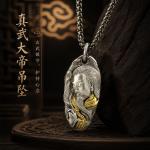
Wudang Mountain has been Zhenwu's seat since the Ming, and its palaces and temples take him as the principal deity, with incense continuing to this day. The pendant and the necklace differ in their fittings. The single pendant takes a cord, and a darker cord holds it better; the necklace version comes fitted and falls at the chest with the face outward. The pendant is made thick, so it does not print its outline through clothing. The copper hall on the golden summit at Wudang was cast in the Yongle era, its components made in Beijing and assembled on the mountain. The chain passes through the hole at the top, so the piece cannot be worn back to front.