


Menu
By theme
By theme


{{ variable.name }} : {{ variable.values[selectedVariantsIndex[variable_index]].name }}
Quantity:
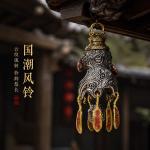
The earliest Chinese bronze bells were excavated at Erlitou. That one is a winged bronze bell with a flanged ridge on one side of the body and its clapper still inside; when it was found it was wrapped in fabric. It dates to the late Xia, far earlier than the Shang and Zhou chime bells. Once the form of a bell was settled it changed very little, and bronze bells across several thousand years still share the same skeleton. The pitch depends on the size of the cavity: a large cavity sounds low, a small one high, and the tone has to be tested while the bell is being made.
In the old days bells had more uses than they do now. Hung on a cart it was a cart bell, ringing as the cart moved so that pedestrians made way; hung on a horse's neck it was a horse bell, and a string of horses could be heard a long way off; hung at a door it rang in the wind and served as a doorbell; tied to a child's wrist it let the child be found by sound if he strayed. These uses are recorded in local custom books everywhere, and they all say the same thing: a bell is made to be heard, not looked at.
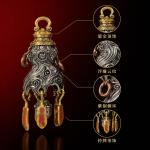
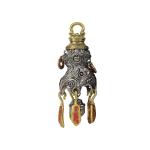
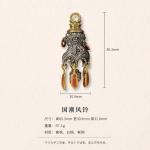
The body is usually of the combined-tile form, two tiles joined, the mouth drawn in, the shoulder narrowed, a loop left at the top for a cord. The advantage of that shape is that the sound is short: strike it and it stops, unlike a round bell that hums on. The clapper may be bronze or wood; bronze gives a crisp note and wood a muffled one, and vintage-style pieces usually take bronze for the clean sound. Clapper and body are a pair, since too large a clapper deadens the note and too small a one lets it flutter. The tone differs on the two sides, which is what the combined-tile form produces.
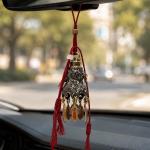
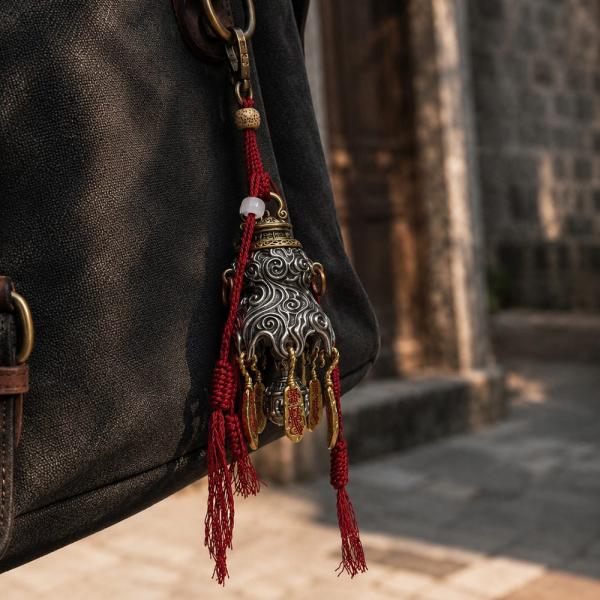
The cord version comes ready, the cord twisted from several colours and closed with a knot, so that it hangs as a strand. The version without a cord is the bell alone, for people who want to fit their own hardware or hang it on an existing bracelet or bag strap. The bell is not large, so it is no burden on a bag, ringing once or twice as you walk without being noisy. Cord colours can be chosen, though a thick cord will not pass the loop and a thin one is not strong enough. The loop hole is small, so the knot must be tied outside it.
A bronze bell dislikes being dropped: once the mouth is out of shape the note goes dull, and that dullness cannot be repaired. If it hangs outdoors and gets rained on, dry it when you come in and shake the water out of the cavity rather than letting it sit there overnight. A darkened colour does not affect the sound and makes the bell look more like an old piece. If the knot loosens, retie it; the loop hole is small, so use a finer cord, since a thick one will not pass. For long storage, put a small packet of desiccant in the bag, which does more than any amount of wiping.