


Menu
By theme
By theme



{{ variable.name }} : {{ variable.values[selectedVariantsIndex[variable_index]].name }}
Quantity:
The mountain ghost is not a wild ghost. The name comes from the Songs of Chu, from the Nine Songs, of which the Mountain Ghost is one piece; it describes a deity of the mountains, generally taken for a mountain god, though some read it as a shadow of the goddess of Mount Wu. One line runs, "There seems to be someone in the fold of the mountain, clad in fig leaves and girdled with dodder" — and to be clad in fig and girdled with dodder is a god's dress, not a ghost's appearance. The Nine Songs has eleven pieces in all, and the Mountain Ghost comes toward the middle, a little past centre. The whole piece is in her voice, waiting in the mountains until the wind rises and the trees sound, and no one comes.
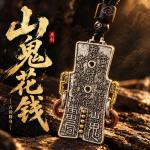
Carving the mountain ghost onto coins was a Qing practice. Charm coins were popular then, not for circulation but for guarding a house, suppressing evil and carrying on the person. The commonest face of a mountain ghost charm carries a spell: it begins with the mountain ghost's thunder, goes on to kill ghosts and subdue spirits, cut down demons and repel evil, forever preserve the spirit's clarity, and ends with the command by the authority of the Supreme Lord Lao. The other face usually bears the eight trigrams or a thunder command, and the two faces together make it complete. In the old days these charms hung behind doors or on curtain hooks and were never spent as money.
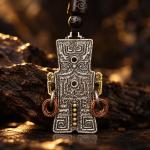
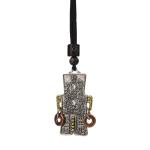
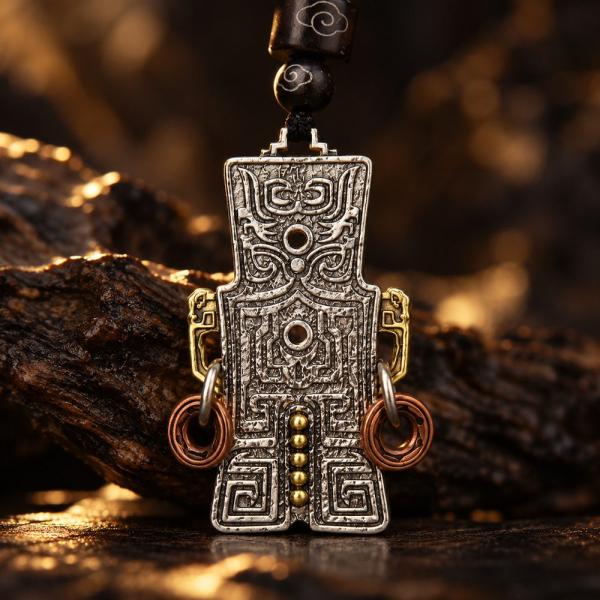
This piece takes the tablet form: rectangular, corners rounded, a fu character on the front and the mountain ghost's talisman on the back. The fu is written in running-standard script, some strokes joined, the blank space left even. A tablet hangs better than a coin shape: the hole is at the top, the load is centred, and it does not hang off to one side the way a square-holed coin does. A line around the edge frames character and talisman together, keeping the face from scattering. The skeleton of the talisman is one vertical and a few horizontals with turns, which at speed looks like a string of joined strokes.
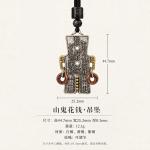
The cord version comes strung and adjusts to whatever length you want; the version without a cord is the tablet alone, for anyone who prefers a cord or chain of their own. The tablet is thin, so it disappears inside a collar and is no bigger than half a palm when shown. Most people who wear this kind of thing do not want it conspicuous, so the small size is right. Choose a plain cord, since the face already carries a talisman and the fittings need not compete. If the hole wears a groove, thread a short length of cord through as a liner and it will last two years more.
The talisman lines are fine and are the first thing on the tablet to blur, so keep your fingers off them. As the copper darkens the strokes of the talisman read more clearly, the darkness filling the hollows like free infill. To brighten it, wipe only the raised areas on the fu side. Take it off for showers, since water that gets into the narrow talisman grooves does not dry easily. The fu side is polished bright and therefore shows scratches sooner, so wipe it gently. Do not wipe the dark out of the talisman hollows: that is the writing, not dirt. The copper needs no frequent wiping; the more you wipe it, the shallower the strokes become.