


Menu
By theme
By theme


{{ variable.name }} : {{ variable.values[selectedVariantsIndex[variable_index]].name }}
Quantity:
The ritual sword is one of the implements of Daoist practice, made in wood and in copper, its blade often cut with the seven stars of the Dipper or with talismanic characters, its grip bound with cord. It is not a weapon for fighting. Its uses are written into the liturgy: guarding the altar, marking a boundary, pointing out a direction. Folk use borrowed the form and made it into a small pendant to hang on the body or behind a door, taking the upright energy of it. How exactly it should be used is a matter each household answers for itself; there is no single rule.
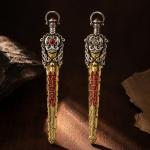
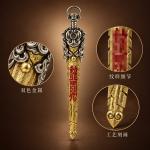
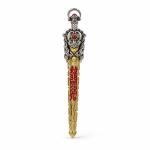
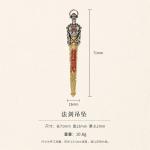
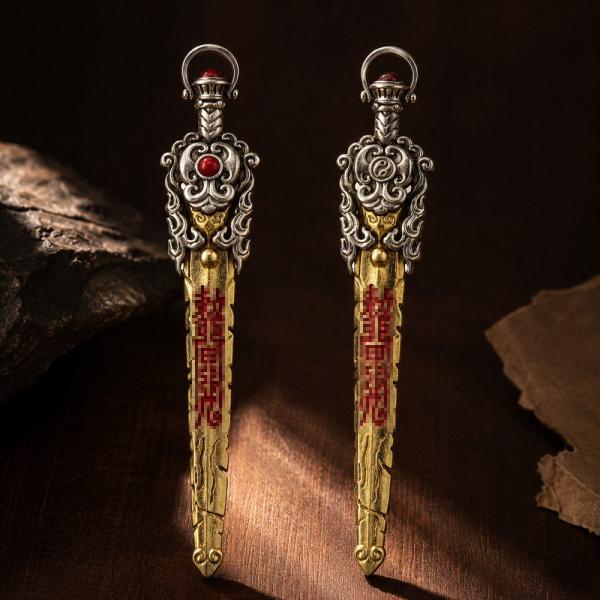
Here the blade is a flat strip with a central ridge. A few horizontal talisman lines are cut near the guard, then comes a stretch of plain surface, and the tip is drawn to a keen point. The grip carries a bound-cord pattern, one coil pressed against the next, and ends in a small ring for the cord. There is no ornament beyond that. The treatment is deliberately totemic, so that at this small size it still reads as a sword rather than a pointed strip of copper.
At pendant scale, proportion is the whole difficulty. On a real sword the grip takes a quarter of the total length, and copying that turns a small pendant into a pin. Here the grip is shortened and the blade drawn out, so it still reads as a sword and does not look clumsy on the body. The angle of the tip has been opened slightly as well: too sharp and it bends, too blunt and the sense of edge is gone. That balance is set by hand and cannot be measured off a drawing. It takes several attempts to settle.
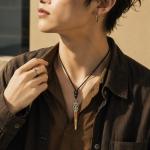
The ritual sword necklace and the ritual sword pendant differ by one chain. The chain is a fine one, hooked to the small ring at the grip, and the pendant hangs vertically as it should instead of turning sideways after two days of wear. People who buy the pendant alone are usually after something to handle, or they have their own cord in mind, and leather suits a plain surface of this kind. Hung behind a door, the cord should be left longer with the tip pointing down. That is the old convention, and the point of it is to keep the edge contained and turned away from people.
Worn on the body, a copper sword rubs against clothing, and the ridge of the blade is the first part to brighten. It reaches a point and then settles, and there is nothing to be done about it. Hung behind a door, away from sweat, oxidation goes much slower and a dark film may take a year to show. When wiping, work in one direction along the blade rather than back and forth across it; crosswise rubbing flattens the ridge. If it falls, look at the tip first. A bent tip cannot be repaired and has to be accepted, which is why it is best to take the piece off and put it on over a table.