


Menu
By theme
By theme






{{ variable.name }} : {{ variable.values[selectedVariantsIndex[variable_index]].name }}
Quantity:
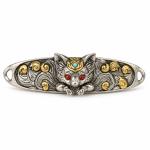
A wrist plate is a flat piece that lies on the back of the wrist. It sits closer than a round plaque and does not rotate after long wear. The nine tails spread from one side of the plate in three groups, staggered in length, the tips curled, filling the empty ground. A fu character is set low on the front, cut shallow so it does not compete with the tails. A narrow border runs the rim, which gives the edge a boundary under the finger, keeps the piece from feeling like a sheet of thin iron, and helps it hold its shape.
The nine-tailed fox first appears in the Classic of Mountains and Seas: on the mountain of Qingqiu there is a beast shaped like a fox with nine tails, and its voice is like a child's. In that setting it is an omen of good fortune, and its appearance in the world meant peace under heaven. Later tellings drifted a long way, and by the novels of the Ming and Qing it had become something else entirely. One image, two traditions, and makers take whichever end suits them. This piece takes the first: the tails are given room, and the air around it is auspicious.
Flat plates are judged on flatness. Cast with even a slight bow and the piece lifts at the edge when laid on the wrist, and a lifted edge digs in. This face is flat, and turned over the underside is flat as well, which says it was straightened after casting. The lines of the tails are fine, some of them close to a hair's thickness, and they hold without breaking, which means the sprue and the vents were placed correctly; the reject rate on work like this is not low. The bed of the fu character is cleaned out with no residue left and the fill sits level.
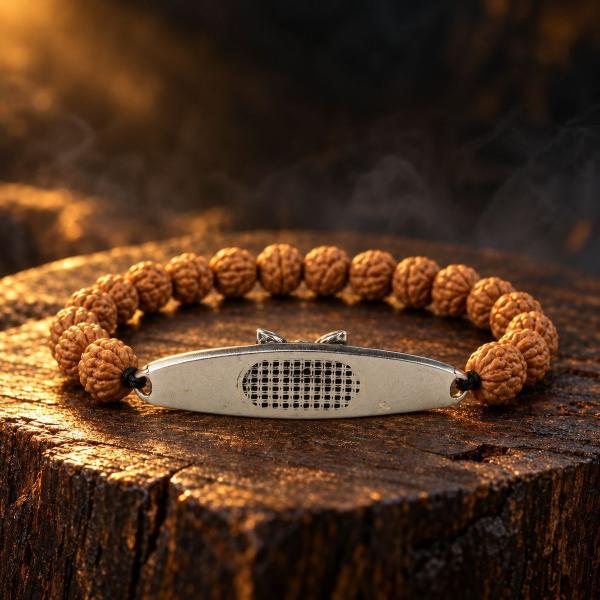
The plate takes either a cord or a chain, with holes at both ends in a symmetrical set of four. With a cord, two strands pass through from either side and meet in a flat knot on the back of the wrist, adjustable for tightness. With a chain, a fine one keeps it light and a leather cord holds it steadier. If your wrist is slender, do not choose too wide a plate. Once the plate is more than two thirds the width of the wrist it looks like a bracer, and a narrower one is neater and does not press on the back of the hand when you raise it.
Sitting against the back of the wrist, the plate takes the most sweat in summer and a dark film forms on its underside. Take it off once a week and wipe it with a dry cloth in one direction rather than rubbing back and forth. The grooves of the tails are shallow and gather dust where you cannot see it; a toothpick with a little cotton wrapped round the tip lifts it out more cleanly than a brush. Do not leave it on a windowsill when it is off. Sun over time fades the antiquing unevenly, light and dark in patches, and then it looks artificially aged in the wrong way, as though someone had scuffed it.