


Menu
By theme
By theme

{{ variable.name }} : {{ variable.values[selectedVariantsIndex[variable_index]].name }}
Quantity:
The story of Zhong Kui is recorded in Dream Pool Essays by Shen Kuo of the Song dynasty. The Tang emperor Minghuang, ill in bed, dreamed of a small demon stealing something, and then of a large demon that caught the small one and ate it, announcing itself as Zhong Kui, a scholar who had come up from Mount Zhongnan for the examinations. The emperor woke cured and had Wu Daozi paint the figure from the dream. Once the story spread, the painted image settled into a fixed type, and the custom of hanging a Zhong Kui picture at the Dragon Boat Festival comes from the same source. Minghuang is Xuanzong, and Wu Daozi was a painter at his court. Those two details hold together.
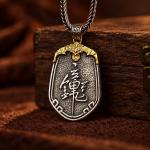
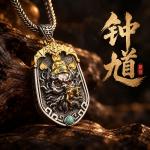
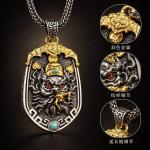
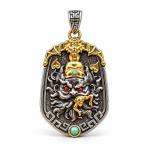
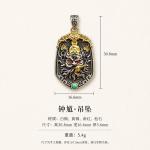
On this plaque Zhong Kui is shown half-length: leopard head, round eyes, an iron-dark face with a curling beard, one hand on a sword, the other shaped as if to seize something. The face takes up half the surface, brow and eyes pressed low, the beard separated into a few heavy lines rather than fine hairs. Only two folds of robe are kept, at the shoulder and the cuff, and the rest is left empty. That subtraction is necessary on a small plaque. Fill it and the face stops reading, and there is nowhere for the light to fall.
Pure copper is not the same material as white copper. Pure copper runs red and warm, oxidises toward deep brown, and after antiquing looks like old bronze. White copper goes blue-white and cool, and its oxidation is grey. The red ground here suits a heavy subject like Zhong Kui; the shadows have somewhere to sink. The metal is on the soft side, so the corners of the relief round off with handling instead of throwing up burrs the way an alloy does, though a knock also leaves a mark more readily. The weight sits in the hand, and the pendant feels substantial.
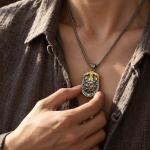
Pendant and necklace are sold separately, and the difference is one chain. A Zhong Kui pendant has weight, so the chain has to carry it; a snake chain that is too fine will stretch over months of hanging. Most people who buy the pendant alone pair it with a red cord. Red against red is a hard clash, and the clash is what holds the figure down. Leave a little play in the knot at the top, or the pendant will hang crooked with the face turned to one side, which looks wrong. Choose a darker chain colour; it keeps the red copper in check.
Pure copper changes colour quickly once it meets sweat, and over one summer it can travel from bright red to deep brown. That is the nature of the metal. If you want to keep the brightness, wipe the piece after each wearing; if you want it to age, leave it alone. The patches left by sweat are mottled and cannot be wiped out, only caught up with as the whole surface oxidises. Do not pick at dirt in the crevices with a needle, which scratches the copper. Sharpen a willow twig to a point and lift it out, or simply leave it; old pieces all carry dust.