


Menu
By theme
By theme




{{ variable.name }} : {{ variable.values[selectedVariantsIndex[variable_index]].name }}
Quantity:
An open fan is a half circle, and a pendant cannot simply be cut to that shape: it would be far too wide and hang like a breastplate. The approach here is to narrow the fan, keep five ribs, put the rivet at the bottom and preserve the curve of the leaf. The sense of something spread open survives while the size comes down to something wearable, and it does not look clumsy over thin summer clothing. The rivet is loose, so the leaf sways slightly as you move.
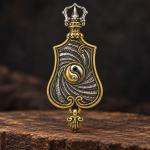
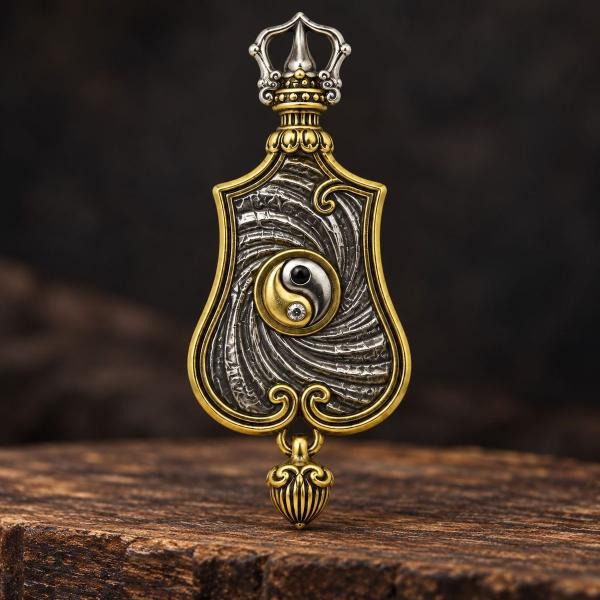
The taiji diagram sits at the centre of the leaf, the yin and yang fish each taking half, their eyes one black and one white. The eyes have to sit at the head of the opposing fish, not in the middle. That is where the diagram is usually got wrong: set them off centre and the whole figure stops turning. A cloud scroll is cut on either side of the leaf, running left to right and closing at the ribs, framing the taiji diagram loosely enough that it can breathe. The two eyes are left slightly raised when the piece is made.
In folk usage the fan carries a pun, since the word for fan sounds like the word for goodness, and giving a fan is giving good intent. Daoist practice also uses the fan as an implement: the palm-leaf fan in the hand of Han Zhongli, one of the Eight Immortals, raises wind and works transformations when he waves it, and stands for magical power. These traditions run on separate tracks. On a pendant, what is taken is the fan spread open and the taiji turning, two ideas that do not need to be forced together.
The two options differ by one chain. On the version with a chain, the chain passes through holes on either side of the rivet and the pendant hangs straight with the leaf facing forward. The pendant alone has a single hole at the top of the fan, so once corded the leaf tips slightly forward. Some people like that angle and find it less rigid. The edge of a fan is curved, and a cord sits against it better than a chain: the knot can settle into the notch at the top.
A fan shape has points, and the two outer corners are the first thing to catch on clothing. Take care with knitwear and sweaters; one snag is enough to bend a corner. White copper has some spring, so a bend can be pressed back, but pad it with a cloth rather than gripping it with pliers. When wiping, follow the curve of the leaf. A straight pass across it leaves a bright line on the curve that stands out badly. The rivet is the part most likely to work loose, so press it back every so often.