


Menu
By theme
By theme

{{ variable.name }} : {{ variable.values[selectedVariantsIndex[variable_index]].name }}
Quantity:
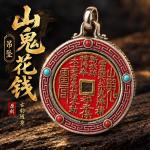
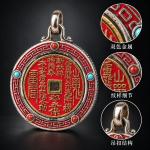
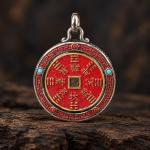
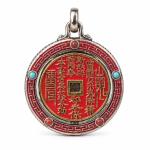
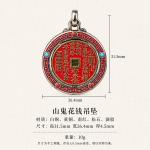
Colour is the first thing to jump off this plaque. The ground sits down inside the engraved lines: the blue leans indigo, the red leans brick, neither of them bright, like old lacquer that has faded a layer. Copper wire stands up between the colours, dividing each patch into small cells, and when light comes in from the side the wire lights first and the colour after, and the depth appears. The ground is not flat-painted. Tiny bubbles are visible in the glaze, the evidence that it has been fired.
A mountain ghost cash is not circulating money. It is a flower coin, also called a yansheng coin, cast to be carried and hung and never spent. Such pieces were most common among the folk in the Qing, a talisman on one face and bagua or a spell on the other, and the mountain ghost is the best known of the type. The name comes from the Nine Songs in the Songs of Chu: the mountain spirit Qu Yuan wrote, draped in creeping fig and bound with dodder, is not the ferocious god of popular imagination. That literary reading and the folk use of the piece as an apotropaic object run on two separate tracks.
Enamel work begins by raising the pattern on a copper body, then fencing the cells with fine copper wire, filling in glaze and firing. Each firing lets the colour sink a little, so you fill and fire again, several times over, before it comes level. Too little heat and the colour goes dull, too much and it blisters; it all comes down to experience at the furnace. The filling here is deliberately short of the brim, leaving a little copper ground at the edges, and that is where the aged look comes from. The glaze has fine crazing, pulled apart because copper and glaze contract at different rates. It is not a crack.
The characters on the front are set close, the turns of the strokes square, horizontals level and verticals straight, not the freehand feel of calligraphy. The back carries the bagua, one cell for each of the eight directions with a circle left in the middle. Both faces have something to look at, so whichever way it hangs it is not empty. A narrow border runs around the rim, holding the patterns of both faces in and giving the polishing wheel somewhere to stop. The edge is not toothed. It is plain, and a cloth will not catch on it.
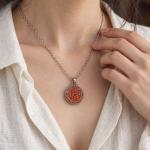
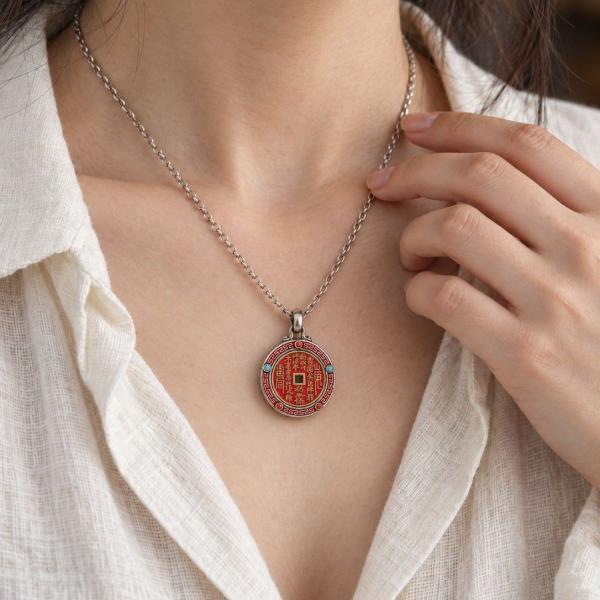
Two versions, the pendant alone and with a necklace. The chain is fine and the clasp small, so it disappears inside a collar. The pendant alone can take a leather cord knotted at the back, length adjusted to taste. Enamel chips: knock out a piece of glaze and it cannot be restored, so take it off for housework or when moving furniture. Do not wear it in the bath either, since hot water and soap will slowly dull the glaze. Store it with soft paper between pieces so that two plaques do not rub against each other.