


Menu
By theme
By theme

{{ variable.name }} : {{ variable.values[selectedVariantsIndex[variable_index]].name }}
Quantity:
The shidao belongs to the nuo altars and the rites of the ritual masters of southern China; it is also called the bell knife. The blade is thin and several iron rings are strung on the butt: shaken during a rite they clash and clatter, and the footsteps follow that sound. It is still seen in nuo opera troupes in Hunan, Guangxi and Guizhou, though the form varies from place to place. Some have saw teeth along the spine, some finish the butt in a mountain shape. The performers treat it as a ritual implement and a prop at once: raise the knife and the audience knows the aria is about to start.
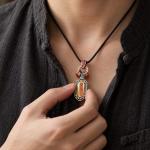
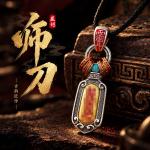
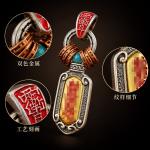
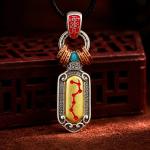
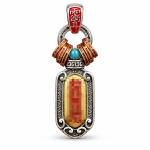
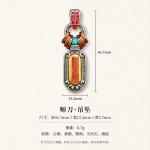
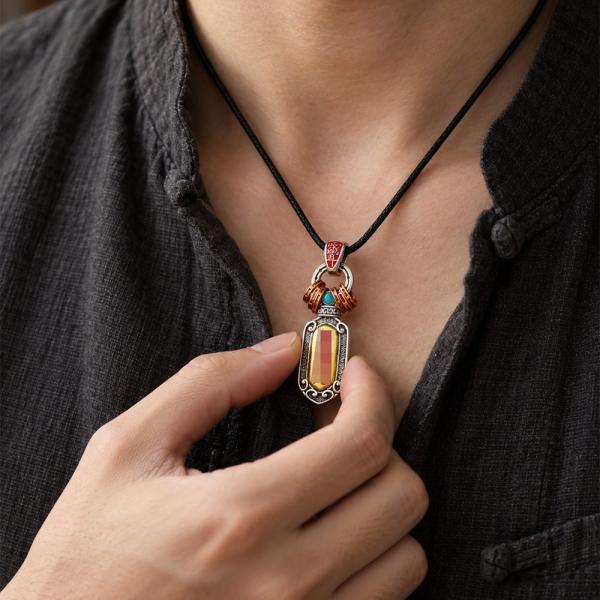
This plaque is made in the shape of the knife, the blade flat and broad, the front drawn to a slanted point, the handle below with a small ring hanging from its end. It stands upright, and on the chest it reads as a narrow long plaque; only up close do you recognise a knife. The spine is straight, the belly slightly convex, a centre line running from end to end. Two bands are wrapped round the handle, imitating the cord binding on the real thing, cut very shallow.
Shrinking a ritual implement into a plaque is mostly a matter of what to leave out. The rings on a real shidao are big and heavy; scaled down they become ornament that will not sound and has no weight. Here the ring is fixed, joined to the butt, keeping only the suggestion of the outline. The blade has been narrowed too: too wide and it looks like a cleaver, too narrow and it looks like a bookmark, and only the middle range stands up. Scaling also shifts the centre of gravity, so the plaque has to be carried by its thickness. Too thin and it looks insubstantial.
There is no carving on the blade face: a single centre line from handle to point, with a shallow ridge raised on either side. That plain treatment leaves the character of the copper exposed, and light falling on it makes a long band of highlight that moves as the angle changes. The back is flat and can be engraved. The cuts are not deep, and a name or a date will fit; more than that and it crowds. The ridges sit equidistant from the edge, so polishing does not overdo one side and skimp the other.
The hole is in the ring at the butt; thread a cord through and knot it. Use a thicker cotton or waxed cord, since a fine chain looks light against a knife shape. Copper darkens where sweat touches it, especially in summer, and a wipe with a dry cloth when you get home is better than saving it all for one big clean. Do not soak it: water collects at the joint between handle and blade and eventually leaves a black line. Waxed cord stiffens when wet, so roll it between your hands before wearing and it softens.